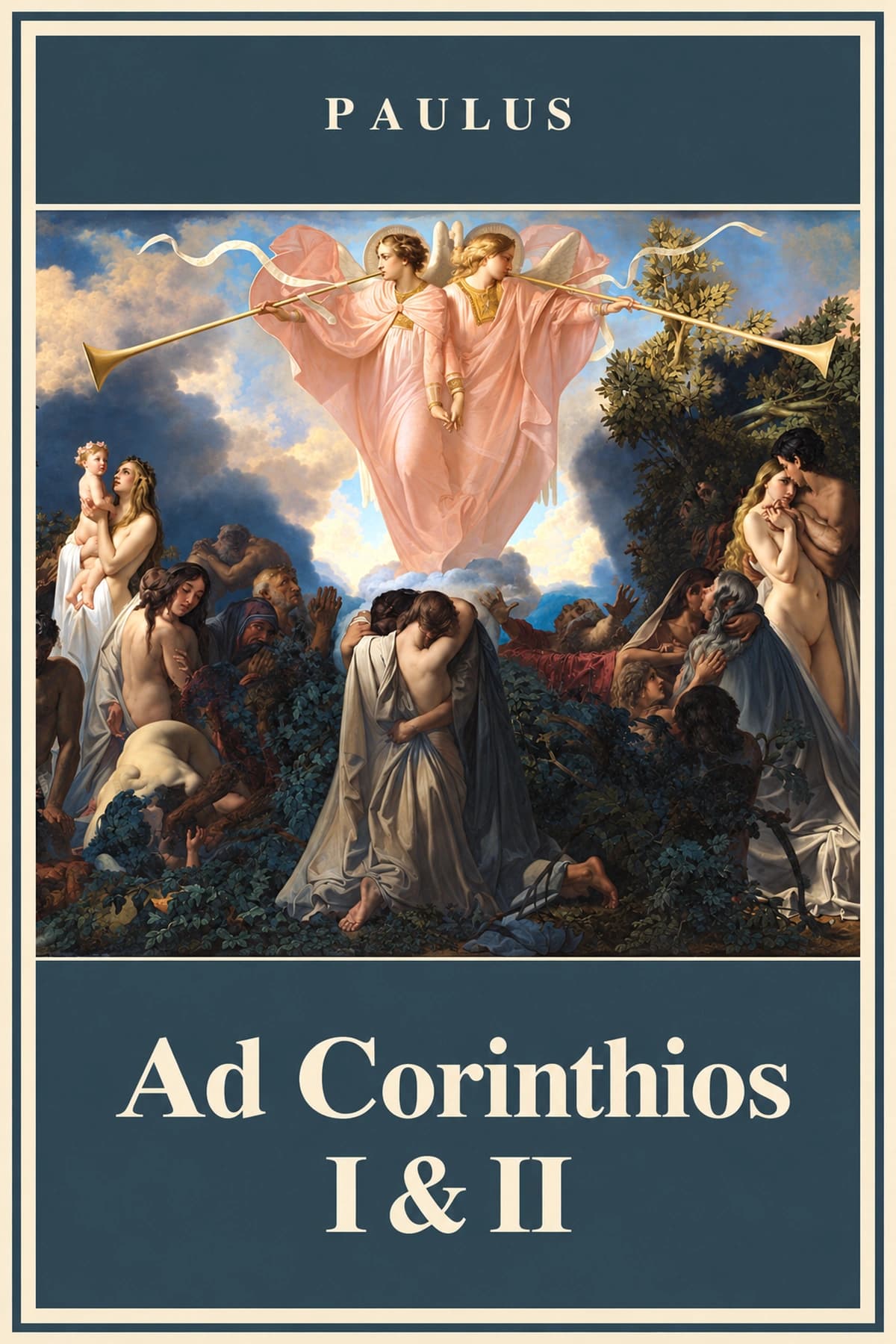
What it is
The Latin text of 1 and 2 Corinthians.
Ad Corinthios is the Vulgate’s name for Paul’s two letters to the church in Corinth. The first deals with a divided and unruly community: factions, lawsuits, marriage, food offered to idols, how to hold the Lord’s Supper, spiritual gifts, and the resurrection of the dead. The second is more personal and turbulent, with Paul defending himself, describing his sufferings, and appealing for the collection for Jerusalem.
This is the Latin text, not a translation. If you came looking for an English version, see the questions below. If you want to read what the Vulgate says, word by word, this is that.
The famous verses, in Latin
Where to find them.
The Latin below is the 1598 Vulgate text as the reader prints it. Tap any word in a quotation for its definition, lemma and form.
1 Corinthians 13:4–7, the love chapter. The 1598 print spells caritas with an h, chāritās, so a search for “caritas patiens est” lands on the same words.
Epistola I, Caput 13
Tap a word — or show the glosses under every word.
Love is patient, is kind; love is not jealous, does not act rashly, is not puffed up, is not ambitious, does not seek its own, is not provoked, thinks no evil; it does not rejoice over wrongdoing, but rejoices with the truth: it bears all things, believes all things, hopes all things, endures all things.
1 Corinthians 13:12, “through a mirror, in a riddle.”
Epistola I, Caput 13
Tap a word — or show the glosses under every word.
For now we see through a mirror in a riddle, but then face to face. Now I know in part, but then I shall know even as I am known.
1 Corinthians 6:19, the body as a temple. The Latin says membra vestra, “your members” or limbs, where many English versions say “your body.”
Epistola I, Caput 6
Tap a word — or show the glosses under every word.
Or do you not know that your members are the temple of the Holy Spirit, who is in you, whom you have from God, and that you are not your own?
More, each linked into the reader:
- 1 Cor 10:31: Sīve ergō mandūcātis, sīve bibitis, sīve aliud aliquid facitis : omnia in glōriam Deī facite, “Whether you eat or drink or do anything else, do it all for the glory of God.” (Read it →)
- 1 Cor 15:55: Ubi est mors victōria tua?, “Where, death, is your victory?” (Read it →)
- 1 Cor 16:14: omnia vestra in chāritāte fīant, “Let all your things be done in love.” (Read it →)
- 2 Cor 9:7: hilarem enim datōrem dīligit Deus, “for God loves a cheerful giver.” (Read it →)
- 2 Cor 12:7: datus est mihi stimulus carnis meae, “a thorn in the flesh was given to me.” (Read it →)
The text
The Vulgate, as printed at Rome in 1598.
The Latin is the Vulgate in the form printed at Rome by the Vatican press in 1598 (Biblia Sacra Vulgatae Editionis, the Clementine edition), pages 1063–1083. Each page was read against the page images, and where the transcription differed from the print it was corrected to the print. The spelling follows the print, including chāritās and poenitet, with long vowels marked.
How hard is the Latin?
Literature level, with a long argument in every sentence.
Ad Corinthios scores 5.0 on Librorum Capsula’s 1–11 difficulty scale (reviewed). For comparison, the Gospel of Mark scores 4.0 and the Acts of the Apostles 4.4. Paul’s sentences are longer and argue in chains, but the vocabulary is the Vulgate’s and comes back constantly.
How to read it
The love chapter is short, famous and repetitive in its grammar, so you will already half-know where it is going.
Chapters 1–3 set the quarrel that drives the letter, in plainer sentences than the later arguments.
Every word has a definition, lemma and form. The 25 notes, most of them from J. J. Lias’s Cambridge commentaries, explain who is who and what Paul is answering.
Chapter 15 is the great argument of the first letter, and the Latin pays the effort back.
In the reader
Both letters, with every word defined.
The reader has the complete text of 1 and 2 Corinthians: 29 chapters and 701 sentences, with long vowels marked throughout, a definition, lemma and form for every word, and 25 notes, most of them from J. J. Lias’s Cambridge commentaries.
Read next
Evangelium Secundum Marcum
The Gospel of Mark in the same Vulgate Latin: a fast narrative after Paul’s long arguments.
Acta Apostolorum
The Acts of the Apostles, which tells how Paul came to Corinth.
Epistulae Morales I-X
Seneca’s letters to Lucilius, a philosopher’s correspondence from the same century.
Sources & further reading
- Biblia Sacra Vulgatae Editionis (Rome: Ex Typographia Vaticana, 1598), pp. 1063–1083
- J. J. Lias, The First Epistle to the Corinthians (Cambridge: University Press, 1881) and The Second Epistle to the Corinthians (1882), for most of the notes