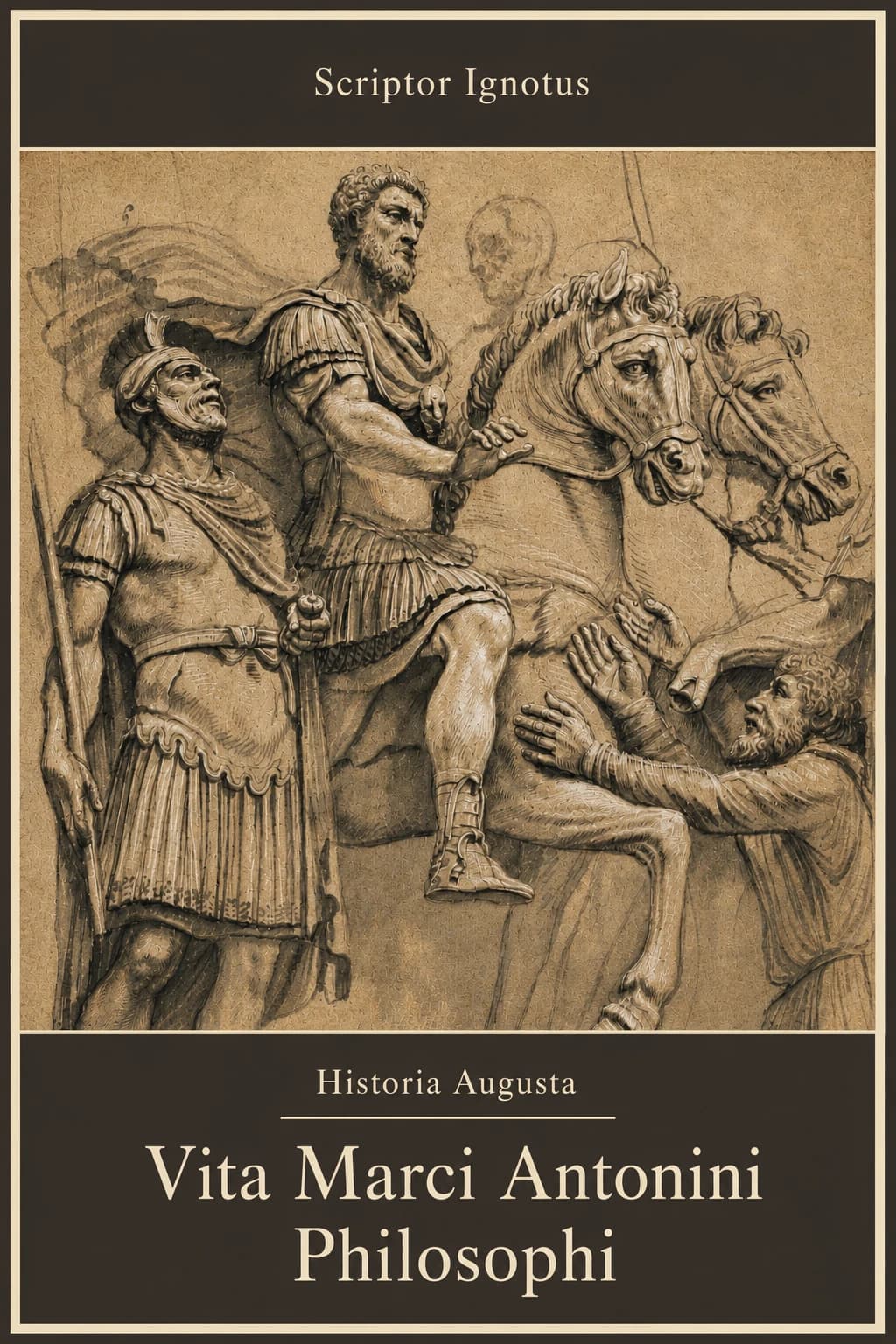
What it is
The Life of Marcus in the Historia Augusta.
The Vita Marci Antonini follows Marcus Aurelius from his childhood and serious education through his adoption into the imperial family and accession to the throne. It describes his philosophical teachers and habits, his partnership with Lucius Verus, his government of the empire, his wars, the rebellion of Avidius Cassius, and his death. The biographer is strongly interested in his character: self-control, conscientiousness, clemency, devotion to study and sense of duty. It opens with a dedication that sums him up:
Historia Augusta · Vita Marci
Tap a word — or show the glosses under every word.
To Marcus Antoninus, a man who was a philosopher in all his life and who surpassed all emperors in the holiness of his life.
The boy
Annius Verissimus, “the most truthful”.
Marcus was born in Rome in AD 121 on the Caelian Hill, in his grandfather’s gardens, and grew up in his grandfather’s house. The biographer says he was serious from infancy, and records a nickname:
Historia Augusta · Vita Marci
Tap a word — or show the glosses under every word.
After his father’s death he was called Annius Verissimus by Hadrian, and after he took the toga of manhood, Annius Verus.
His education is the point of the early chapters. He is handed to great teachers and comes to philosophy:
Historia Augusta · Vita Marci
Tap a word — or show the glosses under every word.
Such was his devotion to philosophy that even after he had been taken into the imperial family he still came to the house of Apollonius to learn.
The Stoic emperor
“He never changed his face for grief or joy.”
The biographer’s portrait is of a ruler of unshakable calm, trained in Stoicism by the best teachers:
Historia Augusta · Vita Marci
Tap a word — or show the glosses under every word.
For he was himself of such calm that he never changed his expression for grief or joy, devoted to Stoic philosophy, which he had received from the best masters and gathered from every side himself.
Marcus had little chance to be calm in peace. The life records the Parthian war, the Marcomannic war and the plague that killed thousands in the city and the army:
Historia Augusta · Vita Marci
Tap a word — or show the glosses under every word.
So great was the plague that corpses were carried out on carts and wagons.
The end
“Why weep for me, and not think of the plague?”
The death scene gives Marcus a last Stoic remark. On the sixth day of his illness he calls his friends together:
Historia Augusta · Vita Marci
Tap a word — or show the glosses under every word.
On the sixth day he called his friends, and, laughing at human affairs and despising death, he said to them: “Why do you weep for me, and not rather think about the plague and the death we all share?”
The biographer then turns to Marcus’s son Commodus, saying that such a man left a son behind and that, had he been fortunate, he would have left none, and repeating the rumours about Commodus’s birth. The Historia Augusta is full of dubious anecdotes, so such stories should be weighed carefully.
Reading it critically
Not modern biography, not mere fiction.
The Historia Augusta is a collection of imperial lives that presents itself as the work of several earlier biographers but is thought to be by one author in the late fourth century. It has a deserved reputation for invented documents and literary games. The Life of Marcus belongs to its earlier and generally more trustworthy part, but it is best treated as an ancient witness to be checked against other evidence, and as a record of how later Romans remembered the philosopher on the throne.
How hard is the Latin?
Plain biographical prose, with a lot of names.
The Vita Marci scores 5.6 on Librorum Capsula’s 1–11 difficulty scale: Intermediate, and easier than Caesar’s De Bello Gallico I (6.3). What to watch for:
- Names and offices. The opening chapters run through family trees and magistracies, which look hard but repeat the same few terms.
- Late Latin habits. Participial phrases and loose connectives replace the tighter periods of Cicero.
- Roman numerals. Dates and counts are given in numerals (VI. kal. Maias).
In the reader
The whole life, chapters I–XXIX, with every word defined.
The reader has the Latin of chapters I–XXIX, about 5,500 words, from the Loeb Classical Library edition (volume 139, 1921), collated against the printed pages. Every word has a definition, lemma and form, and long vowels are marked.
Read next
Sources & further reading
- Loeb Classical Library vol. 139 (1921), as recorded in the reader’s source note (Latin text through Avidius Cassius, ed. Susan H. Ballou; printed pp. 132–204) — the edition the reader follows