What it is
A Roman cabinet of curiosities.
Gaius Iulius Solinus was a Roman-era compiler whose Collectanea Rerum Memorabilium, “a collection of memorable things”, gathers geography, natural history, mythology and remarkable traditions into a tour of the known world. Much of it is drawn from earlier writers, above all Pliny the Elder, and it was popular for centuries. Its island-by-island, people-by-people movement makes it good reading in short pieces, because each wonder is self-contained.
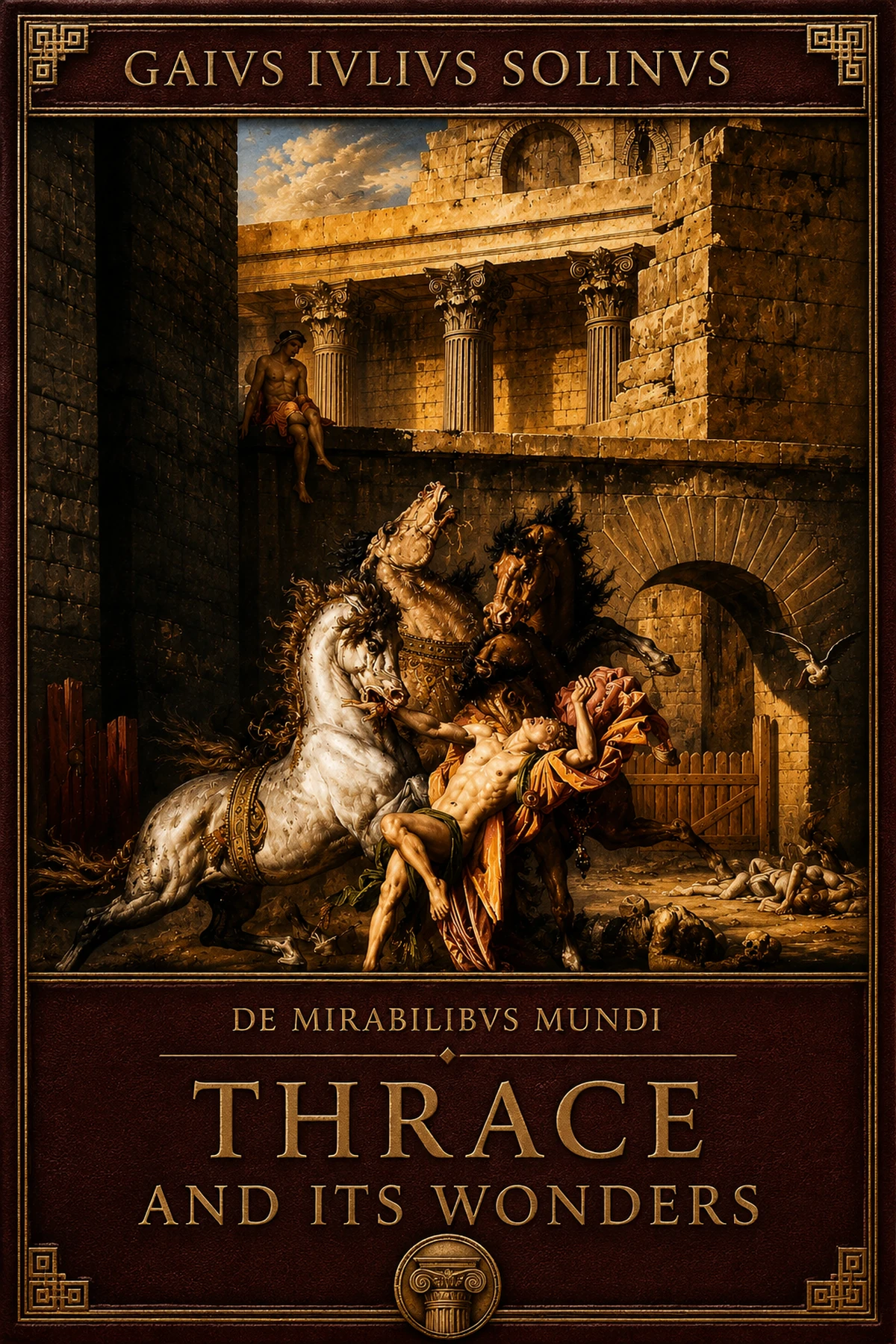
Thrace
Where birth is mourned and death is celebrated.
Chapter X turns north from the Aegean to the tribes of Thrace. Solinus says they have a contempt for life, which comes from a kind of natural wisdom, and describes customs that reverse the usual ones:
Solinus · Thrace, chapter X
Tap a word — or show the glosses under every word.
Among most of them births are occasions of mourning, and a parent greets a newborn with tears; on the contrary, funerals are joyful, so much so that they escort the dead with rejoicing.
The chapter goes on to marriage by auction, to widows who throw themselves onto their husbands’ funeral pyres, and to the places and peoples of the Thracian coast, including the home of Orpheus and Democritus’s city of Abdera.
The Aegean
Crete: no snakes, and a tomb of Jupiter.
Chapter XI sails from Crete through the Cyclades and Sporades, with myths, animals, inventions and natural wonders along the way. On Crete, Solinus reports the tomb of Jupiter and a land of curious natural history:
Solinus · The Aegean Islands, chapter XI
Tap a word — or show the glosses under every word.
Varro, in his work on the coasts, affirms that even in his own time the tomb of Jupiter was visited there.
Solinus · The Aegean Islands, chapter XI
Tap a word — or show the glosses under every word.
No snake, plentiful vines, wonderful kindness of the soil, abundant tree crops: for in only one part of this island do cut cypresses grow again.
Libya and Ethiopia
Long-lived men, gold chains and dragon stones.
The third selection goes south from the Garamantes into Ethiopia and Libya, to salt-built houses, a spring that is hot and cold, giraffes and rhinoceroses. Beyond Meroe, Solinus puts a people with a long life and a just character:
Solinus · Libya and Ethiopia
Tap a word — or show the glosses under every word.
These Macrobii cherish justice, love fairness, are very strong in body, are distinguished by special beauty, are adorned with bronze, and make chains for criminals out of gold.
And among the dragons, there is a stone that exists only if it is taken from a living creature:
Solinus · Libya and Ethiopia
Tap a word — or show the glosses under every word.
The stone dracontia is cut from the brains of dragons, but it is not a stone unless it is taken from them alive: for if the serpent dies first, its hardness dissolves and the stone vanishes with its life.
Read it as a Roman did
Marvels reported, not tested.
Solinus is a collector, not an investigator: he passes on wonders as the tradition reports them and often names his source. The marvels are better read as a record of what Romans believed about the edges of their world than as natural history.
How hard is the Latin?
Compact and name-heavy, but in short pieces.
The three selections score 5.5–6.0 on Librorum Capsula’s 1–11 difficulty scale: Intermediate, a little easier than Caesar’s De Bello Gallico I (6.3). What to watch for:
- Place and people names. Many Greek and African names, all defined in the reader.
- Compressed sentences. Solinus packs facts into short, balanced clauses, so slow reading pays.
- Learned vocabulary. Animals, stones and plants have technical names; each is glossed.
In the reader
Three selections, with every word defined.
Each selection has a definition, lemma and form for every word, with long vowels marked. Thrace and the Aegean follow Mommsen’s 1895 edition, collated against the printed pages (pp. 67–71 and 71–77) and cross-checked against The Latin Library; Libya and Ethiopia are from the same edition.
The Aegean Islands
Crete, the Cyclades and the Sporades: myths, animals and inventions.
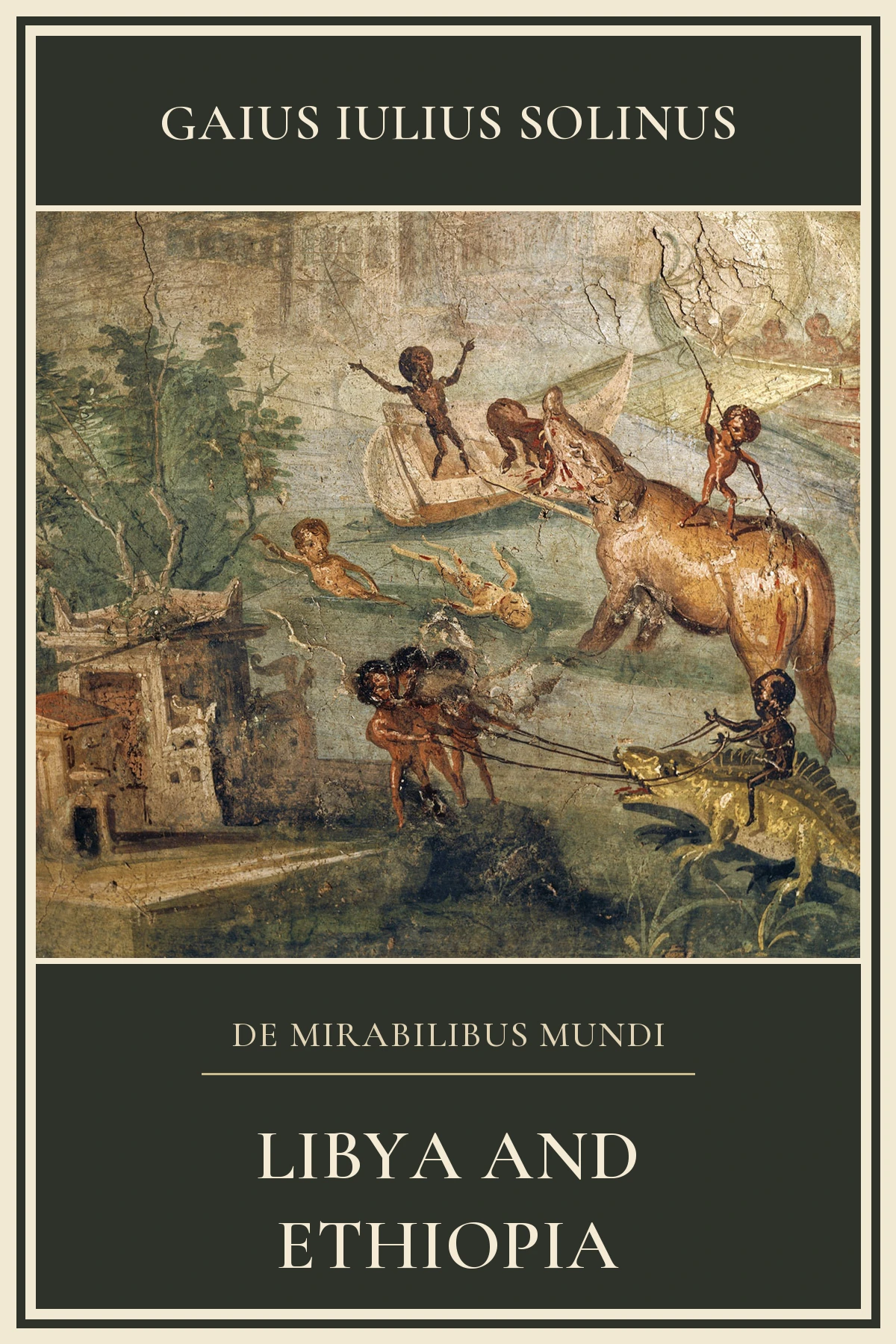
Libya and Ethiopia
Salt houses, long-lived peoples, dragons, giraffes and the edge of the world.
Read next
Itinerarium Egeriae
A nun’s account of her pilgrimage through the Holy Land, Egypt and Asia Minor.
Gerald and the Werewolves
Gerald of Wales and the werewolves of Ossory.
Sources & further reading
- Theodor Mommsen (ed.), C. Iulii Solini Collectanea rerum memorabilium (Berlin, 1895) — the edition the reader follows
- The Latin Library, Solinus — used as an external cross-check