The story
A rich man, a tomb and a pack of dogs.
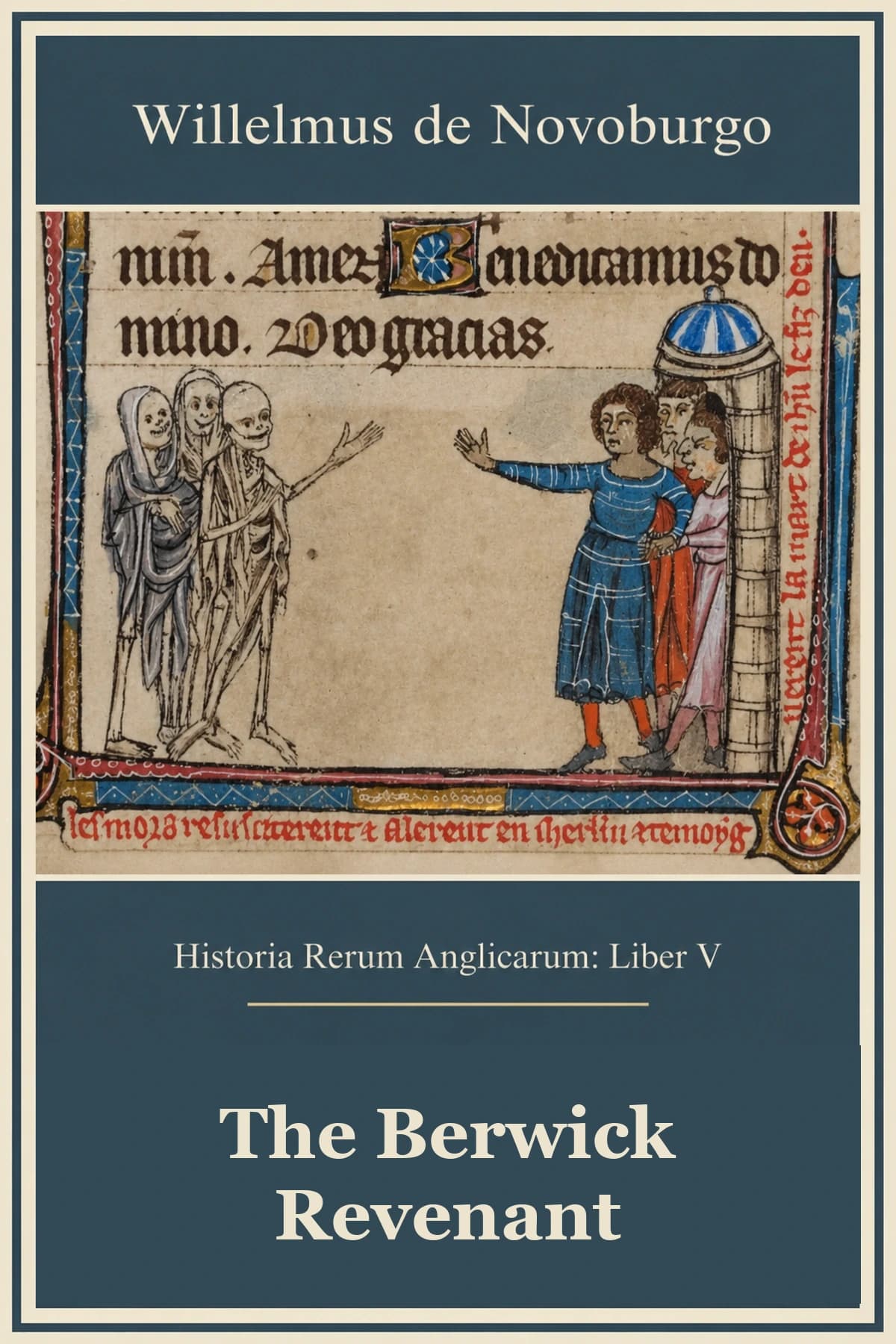
Berwick, William says, is a noble town at the mouth of the river Tweed, belonging to the King of Scots. A man there, rich but thoroughly wicked, as became clear later, dies and is buried. Then, by the work of Satan as people believe, he begins coming out of his tomb at night:
William of Newburgh · Historia rerum Anglicarum V.23
Tap a word — or reveal the translation.
By night he would come out of his tomb and roam here and there, with a pack of dogs following him, barking wildly.
Before dawn he goes back. This goes on for many days, until no one dares to be out of doors after dark. The town’s leading men and ordinary citizens meet to decide what to do. The simpler folk are afraid the lifeless thing will attack and beat them. The wiser ones fear something worse: that the pestilent corpse wandering among them will corrupt the air and bring sickness and death, as had happened in other such cases.
So they hire ten young men known for their daring to dig the body up, cut it limb from limb, and burn it. The haunting stops. It is even said that the monster, while Satan carried it about, told some people the town would have no rest until it was burned. But the story doesn’t end there. Peace seemed to come, and then a plague broke out and carried off most of the people of Berwick. William notes that it struck nowhere else so hard, though it was everywhere in England at the time.
The “Berwick vampire”
Was the Berwick revenant a vampire?
Not in the modern sense, and William never uses the word, which didn’t exist yet. He calls the dead man a monstrum and a prōdigium. Nobody’s blood is drunk: what people fear is being beaten by the corpse, and the disease its rotting body might spread. Modern retellings call him “the Berwick vampire” because the cure is the one later vampire stories use: dig up the body and destroy it.
What the Latin is like
Short, but not easy.
It is short (233 words) but demanding: it scores 7.6 on Librorum Capsula’s 1–11 scale (reviewed), with an entry of 6.5 and a peak of 8.3. Almost the whole chapter is a few very long sentences: one of them carries the town meeting, both sides’ fears and the reason for them, all in one breath. If you can read Caesar comfortably, it’s a satisfying challenge. If not, start with an easier story and come back.
In the reader
The whole chapter, with every word defined.
The whole chapter, Historia rerum Anglicarum Book V, chapter 23, in Richard Howlett’s edition (London, 1885): 233 words in 9 sentences. Long vowels are marked throughout, every word has a definition, lemma and form, and a note from Howlett’s apparatus records that one manuscript leaves the chapter out.
Read next
Roman ghost stories and Latin horror stories →