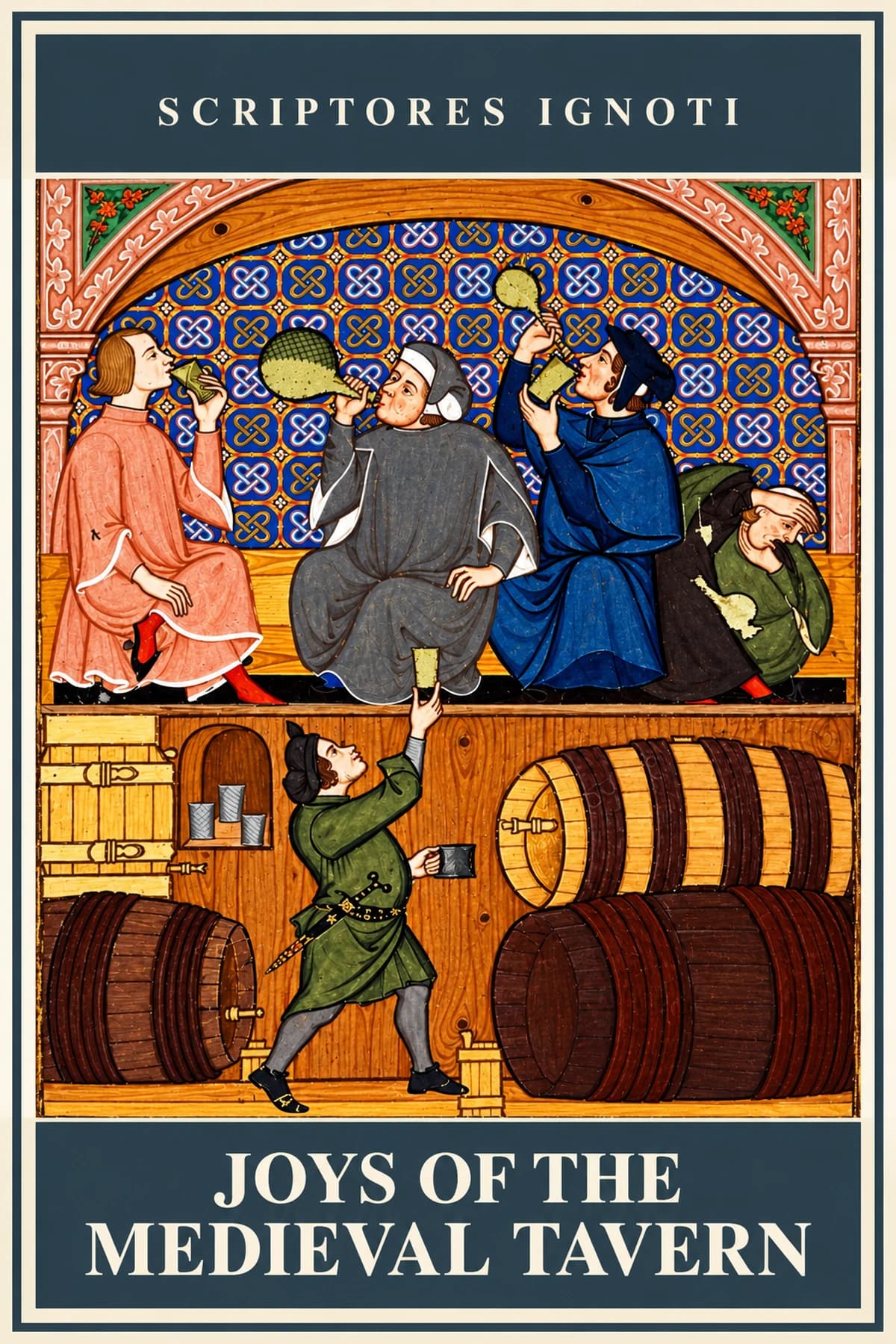
The song
“We do not care what the earth is.”
In taberna quando sumus is Carmina Burana no. 175 in Johann Andreas Schmeller’s 1847 edition, the first printing of the manuscript. The poem begins with the tavern as a place that makes death unimportant:
Carmina Burana · In taberna quando sumus
Tap a word — or show the glosses under every word.
When we are in the tavern, we do not care what the earth is, but hurry to the game, over which we always sweat.
Humus, “the earth”, is usually read as the grave. The next lines say that money is the barman there, and that whatever the poet says, he wants a hearing. Then the game begins, and the dicing has its costs:
Carmina Burana · In taberna quando sumus
Tap a word — or show the glosses under every word.
But of those who stay at the game, some are stripped naked; some are dressed there, and some are clothed in sacks.
The toasts
A drink for every kind of person.
The central stanzas count off toasts. One drink for the prisoners, three for the living, four for all Christians, five for the faithful dead, and so on up the numbers: for vain sisters, for woodland soldiers, for perverse brothers, for scattered monks, for sailors, for quarrellers, for penitents, for travellers. The list ends with a line that is easy to remember:
Carmina Burana · In taberna quando sumus
Tap a word — or show the glosses under every word.
For the pope as for the king, they all drink without law.
Then comes the famous run of bibit: the mistress drinks, the master drinks, the soldier drinks, the clergy drinks, the servant drinks with the maid, the quick and the slow, the white and the black, the poor man and the sick man, the exile and the stranger, the sister and the brother, the old woman and the mother, a hundred drink, a thousand drink.
The Drinkers’ Mass
Dolus vobiscum: the liturgy of Bacchus.
The other two pieces in the reader are parodies of the Latin Mass. The priest’s opening words, “I will go in to the altar of God”, become Introībō ad altāre Bachī, “I will go in to the altar of Bacchus”. The call and response of the liturgy turns into this exchange:
Drinkers’ Mass · Gospel Parody
Tap a word — or show the glosses under every word.
Deceit be with you. And with your groan.
The gospel parody has the drinkers go to the tavern, find the table laid and the dice set out, and divide the clothes they have lost:
Drinkers’ Mass · Gospel Parody
Tap a word — or show the glosses under every word.
And the drinkers divided their garments, praising the Barrel and cursing the Dice.
The reader keeps the parodies in Latin with every word defined; knowing the real Latin Mass will make the jokes land.
How hard is the Latin?
Short rhyming lines and a drinker’s vocabulary.
The three pieces score 5.0 on Librorum Capsula’s 1–11 difficulty scale: Intermediate, and easier than Caesar’s De Bello Gallico I (6.3). The song rhymes in couplets, which makes the lines easier to remember. What to watch for:
- Medieval spelling. The reader keeps medieval forms such as ewangelii for evangelii.
- Rare words. nummāta (a penny’s worth), pincerna (barman) and ciphus (cup) are defined in the reader.
- The liturgy. The Mass parodies work by echoing the Latin Mass, so they read faster if you know it.
If medieval Latin is new to you, see our guide to Medieval Latin.
In the reader
Three medieval pieces, with every word defined.
The reader has the tavern song from Schmeller’s 1847 edition (pp. 235–236), collated against page images, and the two Drinkers’ Mass parodies from Kitchell’s 2016 reader. Every word has a definition, lemma and form, and long vowels are marked. The reader notes that the speaker letters printed with the Mass lines are not expanded in the source and are not shown.
Read next
Two Medieval Fables
A toad, a hare, a fox and a wolf in two short fables.
A Pound of Flesh
The tale that inspired Shakespeare’s merchant and his pound of flesh.
Sources & further reading
- Johann Andreas Schmeller (ed.), Carmina burana (Stuttgart, 1847), no. 175, pp. 235–236 — the tavern song as the reader prints it
- Kenneth F. Kitchell Jr., The Other Middle Ages: A Medieval Latin Reader (2016), Ritual section — the source of the two Drinkers’ Mass parodies