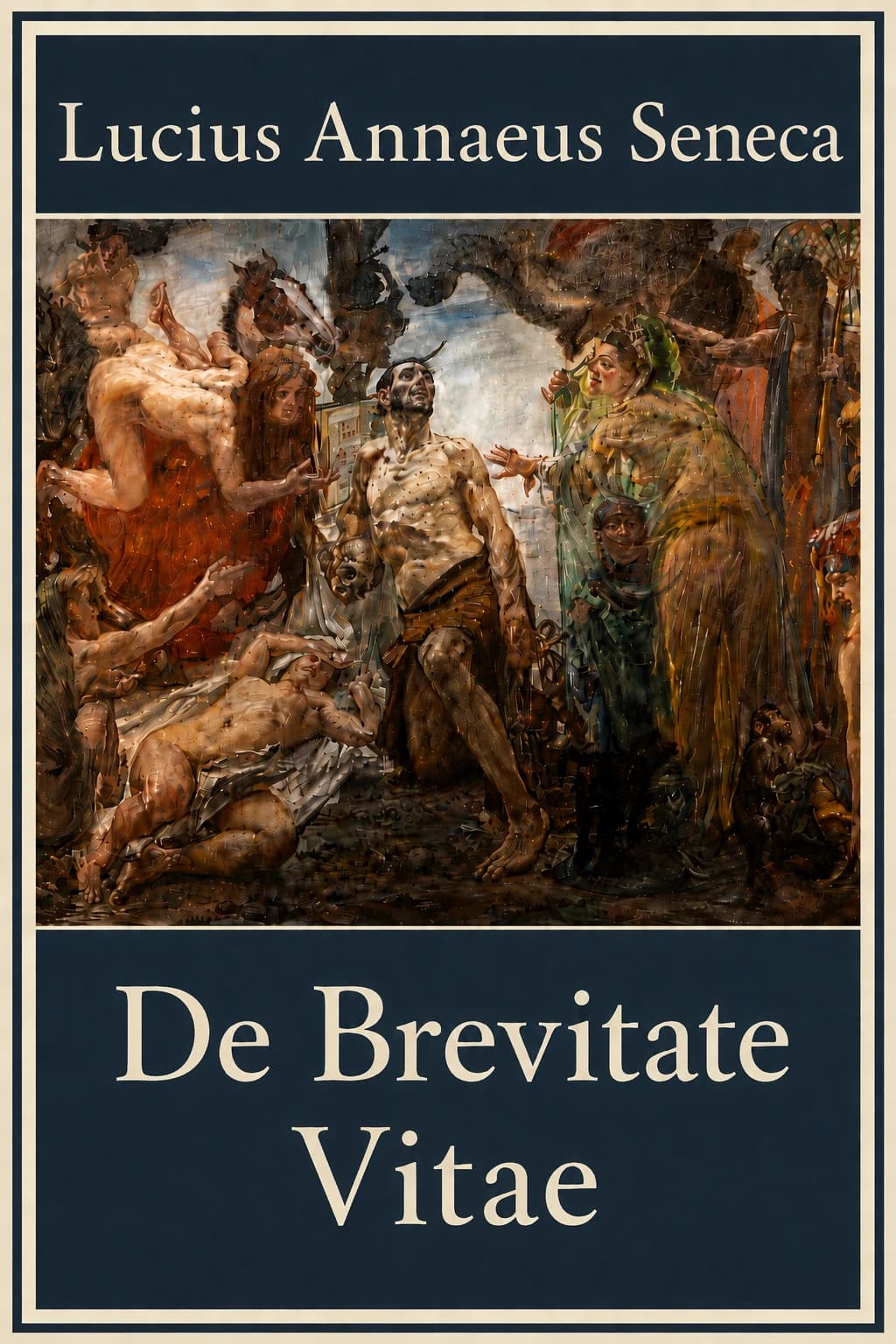
What it is
Advice to a busy man that turns on the reader.
Seneca frames the essay as advice to Paulinus, his father-in-law, whose post overseeing Rome’s grain supply had eaten up his life. He urges him to retire. Then the argument turns on the reader: the time we hand over to ambition, status, distraction and obligations we never chose.
What the Latin is like
Short, pointed sentences built to be remembered.
Seneca writes in short, pointed sentences built to be remembered, and he argues with anger and wit. On LC’s difficulty scale the essay scores 6.2, toward the upper end of Intermediate: harder than a teaching text, gentler than Cicero.
A first look at the Latin
Non exiguum temporis habemus: the essay in one sentence.
Seneca · De Brevitate Vitae 1.3
Tap a word — or show the glosses under every word.
We do not have a short time; we have wasted a great deal of it.
This is the sentence the whole essay defends. Exiguum (“a small amount”) takes the genitive temporis, “of time”, and perdidimus is perfect: “we have lost”. Two clauses, set against each other by sed, with the point saved for the end: that is Seneca’s style in miniature, and most of the essay is built the same way.
In the reader
The whole essay, with every word defined.
The reader has the essay as printed in the Latin Library text, collated page by page against the printed edition, about 6,100 words. Display text is macronized.
Read next
Epistulae Morales in Latin → · Hercules Furens in Latin →
Epistulae Morales I-XXV
Letters I–XXV, short and personal: see the same author in conversation with Lucilius.
Hercules Furens
The same author in verse: mythological tragedy rather than moral argument.