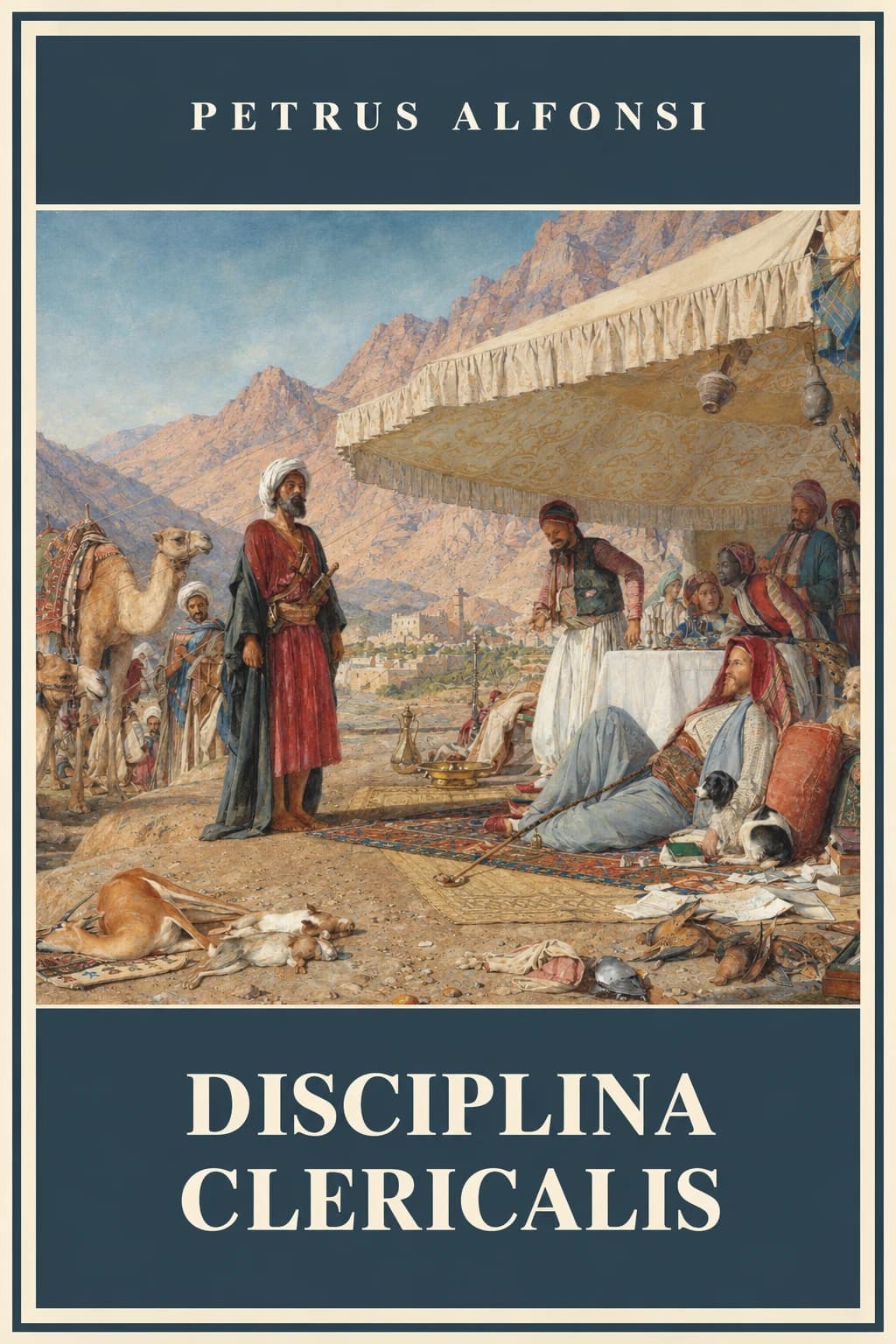
What it is
What is the Disciplina Clericalis?
The Disciplina Clericalis, “a training for clerics”, is a handbook of practical wisdom written in the early twelfth century by Petrus Alfonsi. Alfonsi was a Jewish scholar from al-Andalus who was baptized in 1106, and he opens by saying why he wrote: to make a cleric well trained, and to be useful to many. It teaches the way people have always taught, through sayings and stories.
The frame is a conversation. An Arab father advises his son, and a master answers his pupil’s questions. In between their proverbs come 34 tales, many drawn from Arabic and other eastern collections. The book was copied and translated all over medieval Europe, and its tales turn up again in later collections, among them printed editions of Aesop.
A tale to start with
The half-friend: “Do not praise a friend until you have tested him.”
In the third chapter a dying father asks his son how many friends he has won. A hundred, says the son. The father has managed only half a friend in his whole life, and he tells his son to test them:
Disciplina Clericalis, chapter 3
Tap a word — or show the glosses under every word.
Do not praise a friend until you have tested him.
The test is a calf, cut up and hidden in a bloody sack. The son goes to each friend in turn and says he has killed a man and needs the body buried in secret. All hundred send him away. Then the father sends him to his one half-friend, who takes him in at once:
Disciplina Clericalis, chapter 3
Tap a word — or show the glosses under every word.
Many are friends while they are being counted, but few in time of need.
The thief and the moonbeam
“Latro fuī”: a thief overhears a secret.
A thief climbs onto a rich man’s roof and listens at the smoke-hole to find out whether anyone is awake. The householder notices and, speaking softly to his wife, tells her to ask him loudly where his great wealth came from. She does. He pretends to give in:
Disciplina Clericalis, chapter 32
Tap a word — or show the glosses under every word.
See that you tell no one our secrets: I was a thief.
He invents a charm: say a word seven times, take hold of a moonbeam, and you can slide down into any house and back out again. The thief, delighted, says the word seven times, grabs the moonbeam and lets go. He falls through the window with a crash and breaks a leg and an arm.
Other tales in the book
Judges, storytellers and dreamers.
- The king’s storyteller. A king who cannot sleep asks for a long story. The storyteller begins with a peasant who must ferry a flock of two thousand sheep across a river in a boat that holds only two, and falls asleep. When the king wakes him, he says the river is wide, so let the peasant finish crossing first.
- The shepherd’s dream. A shepherd dreams that he owns a thousand sheep, and bargains over their price with a dealer until the dream ends. He wakes still shouting his price.
- The rich man’s lost purse. A rich man loses a sack of a thousand talents with a golden serpent in it. The poor man who finds it is accused of keeping the serpent, until a king hears the case.
- The wise sayings between the tales. “Beware of unleavened counsel until it is leavened” is one; the book is full of lines like it, many of them followed by a story.
How hard is the Latin?
Plain sentences, short stories, medieval spelling.
The Disciplina Clericalis scores 4.9 on Librorum Capsula’s 1–11 difficulty scale: Intermediate, and easier than Caesar’s De Bello Gallico I (6.3). The tales are short, self-contained and full of dialogue, which makes it a good first long medieval text. What to watch for:
- Medieval spelling. The reader keeps the spellings of the 1911 edition, so you will meet forms such as sompnium for somnium and heremīta for eremīta.
- Direct speech without quotation marks. Speakers are introduced with dīxit or ait and the speech simply follows.
- Proverbs. Many sentences are sayings in the form “the philosopher says: …”. They are short and worth reading twice.
If medieval Latin is new to you, see our guide to Medieval Latin.
In the reader
All 49 chapters, with every word defined.
The reader has the text of the Disciplina Clericalis, about 15,400 words in 49 short chapters, from pages 1–46 of the edition of Alfons Hilka and Werner Söderhjelm (Helsingfors, 1911), checked word by word against the page images. Every word has a definition, lemma and form, and long vowels are marked throughout. Medieval spellings are kept as printed.
Read next
Moral Anecdotes and Fables
More short tales with a point, in plain Latin.
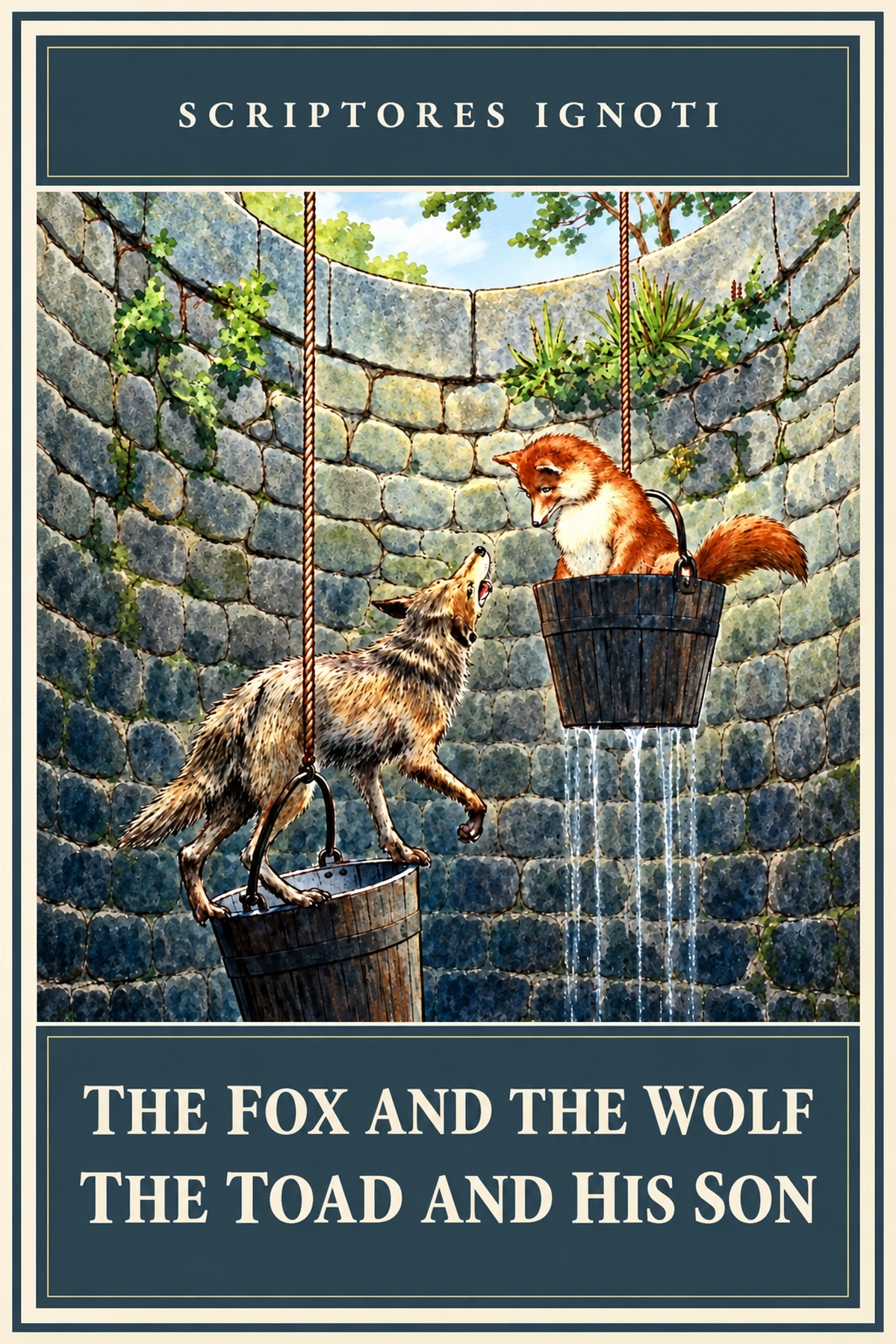
Two Medieval Fables
A toad who thinks his son is the handsomest in the world, and a fox who tricks a wolf into a well.
Jovinian the Proud Emperor
A proud emperor loses his clothes, his throne and his name in a single morning.
Sources & further reading
- Alfons Hilka and Werner Söderhjelm (eds.), Petri Alfonsi Disciplina clericalis (Helsingfors, 1911) — the edition the reader follows
- Wikisource (Latin), Disciplina clericalis — used as an alignment witness