What it is
What is the Gesta Francorum?
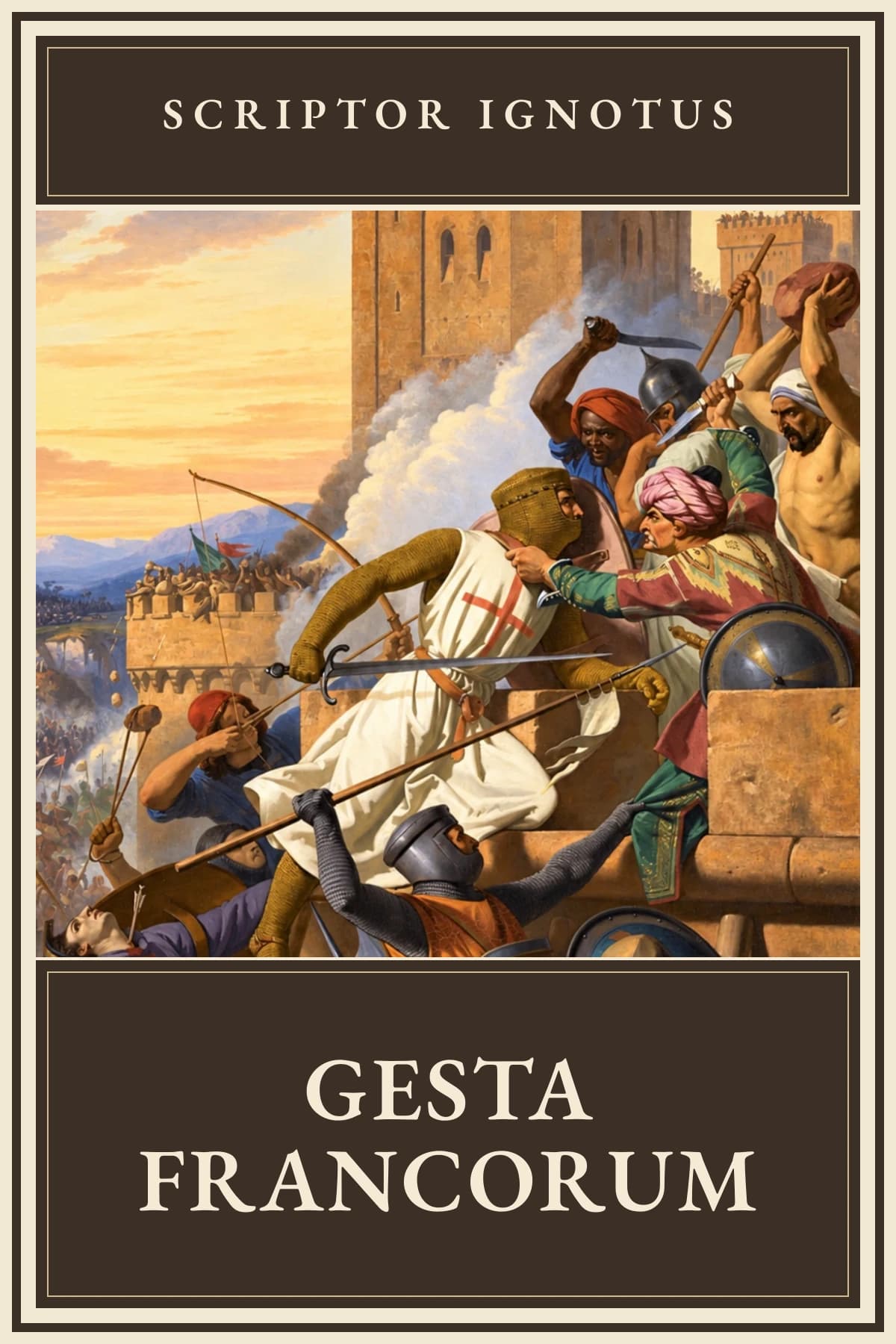
The Gesta Francorum (Latin for “the deeds of the Franks”) is an anonymous account of the First Crusade, written in Latin. It begins with Pope Urban II’s call in 1095, follows the armies through Constantinople, Nicaea and Anatolia, and spends a third of its length on the siege of Antioch, before the march south to Jerusalem. Its full title is Gesta Francorum et aliorum Hierosolimitanorum, “the deeds of the Franks and of the other pilgrims to Jerusalem.” Later chroniclers used it as a source.
This is the Latin text, not a translation. If you came looking for an English version, see the questions below. If you want to read what the author actually wrote, with every word defined, this is that.
The author
Who wrote it?
No one knows. The writer is anonymous, and he writes as a soldier: nōs and nostrī, “we” and “our men,” run through the whole book, and the enemy are Turcī, inimīcī Deī, “the Turks, enemies of God.” He is usually thought to have been in the following of Bohemond of Taranto, whom he calls sapiēns and bellipotēns, “wise” and “mighty in war.” He wrote within a few years of the capture of Jerusalem in 1099.
What’s inside
Ten books, from Clermont to Jerusalem.
- Book I: the call to the Crusade, the Franks setting out in three divisions, and Bohemond joining them.
- Books II–III: Constantinople, the Byzantine emperor, and the siege and surrender of Nicaea.
- Book IV: across Anatolia and Armenia.
- Books V–VIII: the siege of Antioch: skirmishes, desertions, and the traitor inside the walls.
- Book IX: the Turkish relief army arrives, the crusaders are shut in the city and starve, and a pilgrim has a vision of the Holy Lance.
- Book X: the lance is dug up, the crusaders win out of Antioch, then the march south to the siege of Jerusalem.
Five things you’ll find inside
1. A narrator who fights. He does not stand back. Before a battle: Nōs itaque invocantēs Deum vīvum et vērum equitāvimus contrā illōs, “And so, calling on the living and true God, we rode against them.” (Read the chapter →)
2. Hunger at Antioch. Shut inside the city by the Turkish army, the crusaders starve. Nam illī cōnstringēbant nōs ex ūnā parte, et famēs cruciābat ex aliā: “For they pressed us on one side, and hunger tormented us on the other.” A small loaf, he says, was sold for a single gold bezant. (Read it →)
3. A traitor inside the walls. The city falls by treachery: Erat quīdam ammīrātus dē genere Turcōrum, cui nōmen Pirus, quī maximam amīcitiam recēperat cum Boamundō, “There was a certain emir of Turkish stock, named Pirus, who had formed a very close friendship with Bohemond.” (Read it →)
4. The Holy Lance. A pilgrim named Peter swears that Saint Andrew appeared to him and told him where Christ’s lance lay buried in the church of Saint Peter. Et fōdērunt ibi XIII hominēs ā māne usque ad vesperam: sīcque homō ille invēnit lanceam: “Thirteen men dug there from morning till evening, and so the man found the lance.” (Read it →)
5. Arrival at Jerusalem. After three years the army reaches the city:
Liber X, Capitulum XXXVII
Tap a word — or reveal the translation.
How hard is the Latin?
Plain sentences, medieval spelling, a lot of names.
The Gesta Francorum scores 5.7 on Librorum Capsula’s 1–11 difficulty scale (reviewed): Intermediate, a little easier than Caesar’s De Bello Gallico I (6.3). The typical sentence is short and joined with et, vērō and autem, with participles carrying the action and simple reported speech, where Caesar stacks indirect statements and ablative absolutes. Three things make it harder: long lists of leaders and battle-lines (the hardest sentence is the six battle-lines of Book X, ninety-odd words), a handful of long rhetorical sentences, including the 65-word opening with a Gospel quotation, and medieval vocabulary and spelling (Cōrpalātium, ammīrālius, bisanteōs). Proper names are about 8% of the words. If medieval Latin is new to you, see our guide to Medieval Latin.
How to read it
It is the hardest to begin with: sixty-five words and a quotation from the Gospels. The rest of Book I is plainer, and the story speeds up from there.
It is one continuous narrative. Books II, IV, V and VI are the plainest; Books I, III, VII, VIII and IX are somewhat heavier.
Turcī, inimīcī Deī; nostrī; Deō iuvante. The same phrases come back constantly, so the Latin gets easier as you go.
Every name is glossed. The commentary, from Beatrice Lees’s 1924 Oxford edition, explains who is who, and prints the Bible verses the author quotes.
In the reader
All ten books, with every word defined.
The reader has the complete Gesta Francorum: ten books and 39 chapters, about 19,800 words, from Heinrich Hagenmeyer’s 1890 edition. Long vowels are marked throughout, and every word has a definition, lemma and form. It also has 258 notes from Beatrice Lees’s 1924 Oxford edition, and seven maps and medieval miniatures placed where the events they show take place.
Read next
The Knight Who Wanted to See a Demon
A shorter medieval narrative in the same plain style.
Epistola de Insulis Nuper Inventis
Columbus’s 1493 letter on the first voyage, a first-person account of a newly seen world.
Commentarii de Bello Gallico: Liber I
Caesar’s own account of a war, in classical Latin: tighter, with longer sentences and indirect speech.
Sources & further reading
- Anonymi Gesta Francorum et aliorum Hierosolymitanorum, ed. Heinrich Hagenmeyer (Heidelberg: Winter, 1890)
- Beatrice A. Lees (ed.), Anonymi Gesta Francorum et aliorum Hierosolymitanorum (Oxford: Clarendon Press, 1924), Notes
- Rosalind Hill (ed. and trans.), Gesta Francorum et aliorum Hierosolimitanorum (Oxford Medieval Texts, 1962), the standard edition with English translation