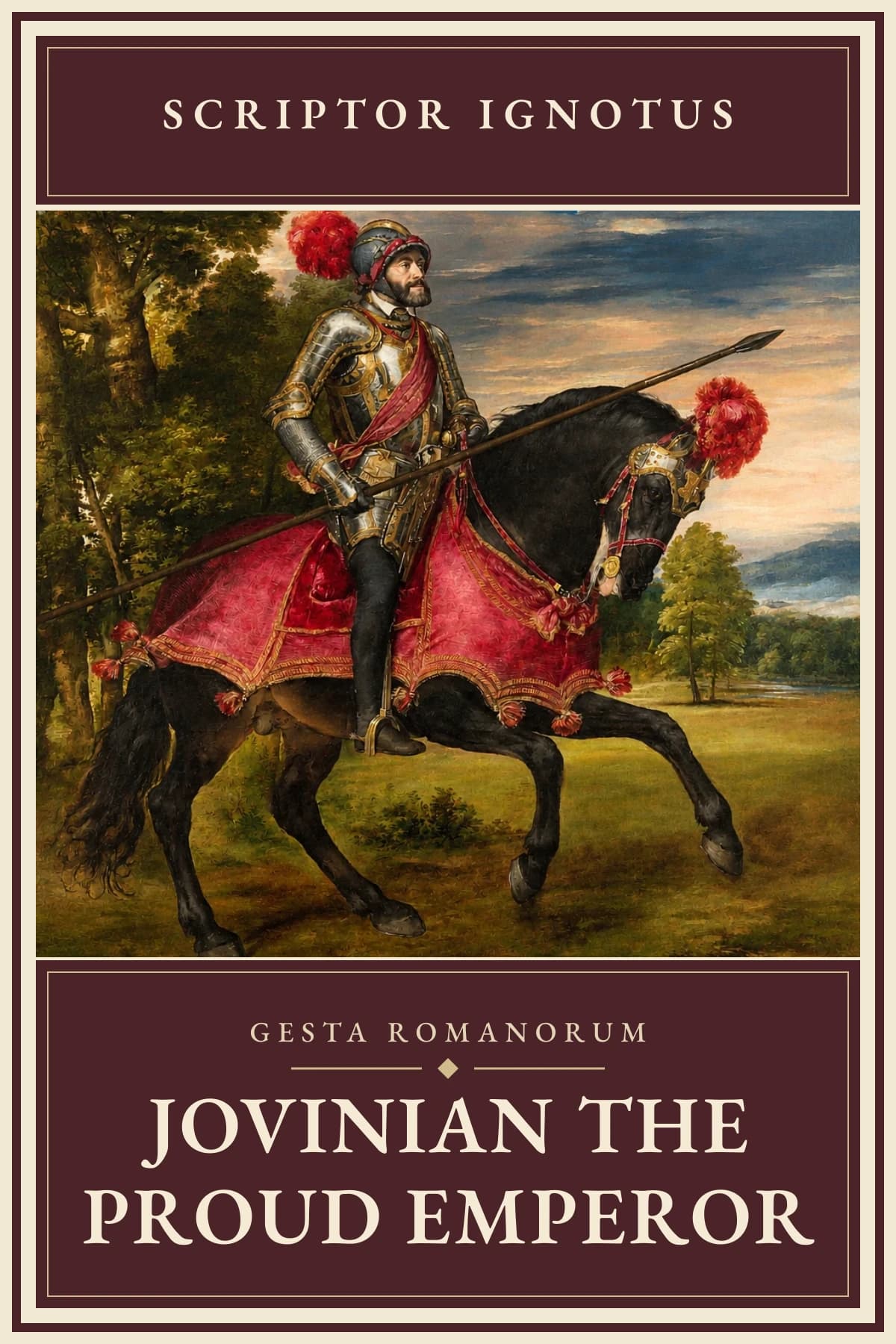
The story
An emperor, a stream and a stolen face.
The tale is one of the stories of the Gesta Romanorum, “the deeds of the Romans”, a medieval Latin collection of short tales that each point to a moral. This one is about pride. It begins with a thought:
Gesta Romanorum · Jovinian
Tap a word — or show the glosses under every word.
Is there any other god than I?
Jovinian falls asleep on it. In the morning he goes hunting, grows unbearably hot, leaves his knights, strips and steps into a stream. A man who looks and sounds exactly like him comes up, puts on his clothes, mounts his horse and rides to the knights, who take him for the emperor.
The fall
Beaten by the knight, jailed by the duke.
Jovinian walks naked to the castle of a knight he once promoted. The porter will not believe him, and neither will the knight, who tells him he is a liar:
Gesta Romanorum · Jovinian
Tap a word — or show the glosses under every word.
You lie, you wretched rascal!
The knight has him flogged and thrown out. The duke he made his counsellor does the same, and adds a prison with bread and water. At the palace even his wife does not know him, though he sends her private signs that only the two of them knew. The dog that loved him leaps at his throat, and the household holds it back; his falcon breaks its leash and flies out of the hall. The false emperor asks the court whom they obey, and sentences the impostor to be dragged at a horse’s tail.
The turn
A hermit’s window and an angel’s speech.
Broken, Jovinian goes to his confessor, a hermit, who shuts the window on him and says he is the devil in human form. Then Jovinian remembers the thought he had in bed, and begs to confess through the closed window. Once he has confessed, the hermit knows him and gives him a few clothes. At the palace the courtiers bow to him, and now two emperors stand in the hall. The other one takes him by the hand and speaks:
Gesta Romanorum · Jovinian
Tap a word — or show the glosses under every word.
His penance is now complete and he has made satisfaction for his sins; from now on obey him. I commend you to God. And he vanished from their sight.
The double was an angel, set to guard the throne while Jovinian learned humility. The emperor thanks God and lives out his life in peace.
An old plot
The same story as Robert of Sicily.
The reader prints two short notes from Charles Swan’s English Gesta Romanorum (1871). One quotes Thomas Warton: this is “also the story of Robert king of Sicily”, an old English poem, and an old French morality play was written on it. The other points to a similar tale in the Persian and Turkish Tales, and calls the assumption of another’s likeness “a common eastern figment”.
How hard is the Latin?
Short sentences, lots of repetition.
The story of Jovinian scores 4.6 on Librorum Capsula’s 1–11 difficulty scale. The plot repeats itself on purpose: he goes to a door, the porter asks who he is, he says he is the emperor, he is thrown out. That repetition makes it easy to follow, and the same few words come back again and again. What to watch for:
- Medieval spelling. michi for mihi, hiis for his, nōticia for nōtitia.
- Direct speech without quotation marks. A speaker is introduced with ait or dīxit and the speech follows.
- Medieval words. ribaldus (a rascal) and miles in the sense of a knight are glossed in the reader.
If medieval Latin is new to you, see our guide to Medieval Latin.
In the reader
The whole tale, with every word defined.
The reader has the narrative of chapter 59 of Hermann Oesterley’s 1872 edition of the Gesta Romanorum, about 1,700 words in 100 sentences, collated against the page images. Every word has a definition, lemma and form. A few quantity positions that could not be sourced are left unmarked, and one sentence is flagged because the text was not checked against a second witness.
Read next
The Pirate's Daughter
A princess, a pirate and a long separation, from the same collection.
Two Medieval Fables
A proud toad-father and a fox who tricks a wolf into a well.
Disciplina Clericalis
Petrus Alfonsi’s book of proverbs and short stories.
Sources & further reading
- Hermann Oesterley (ed.), Gesta Romanorum (Berlin: Weidmann, 1872), chapter 59 — the edition the reader follows
- Charles Swan (trans.), Gesta Romanorum, new edition with an introduction by Thomas Wright (London: John Camden Hotten, 1871), Notes, Note 58 — source of the two notes in the reader