In brief
The story of Jonah, in a paragraph.
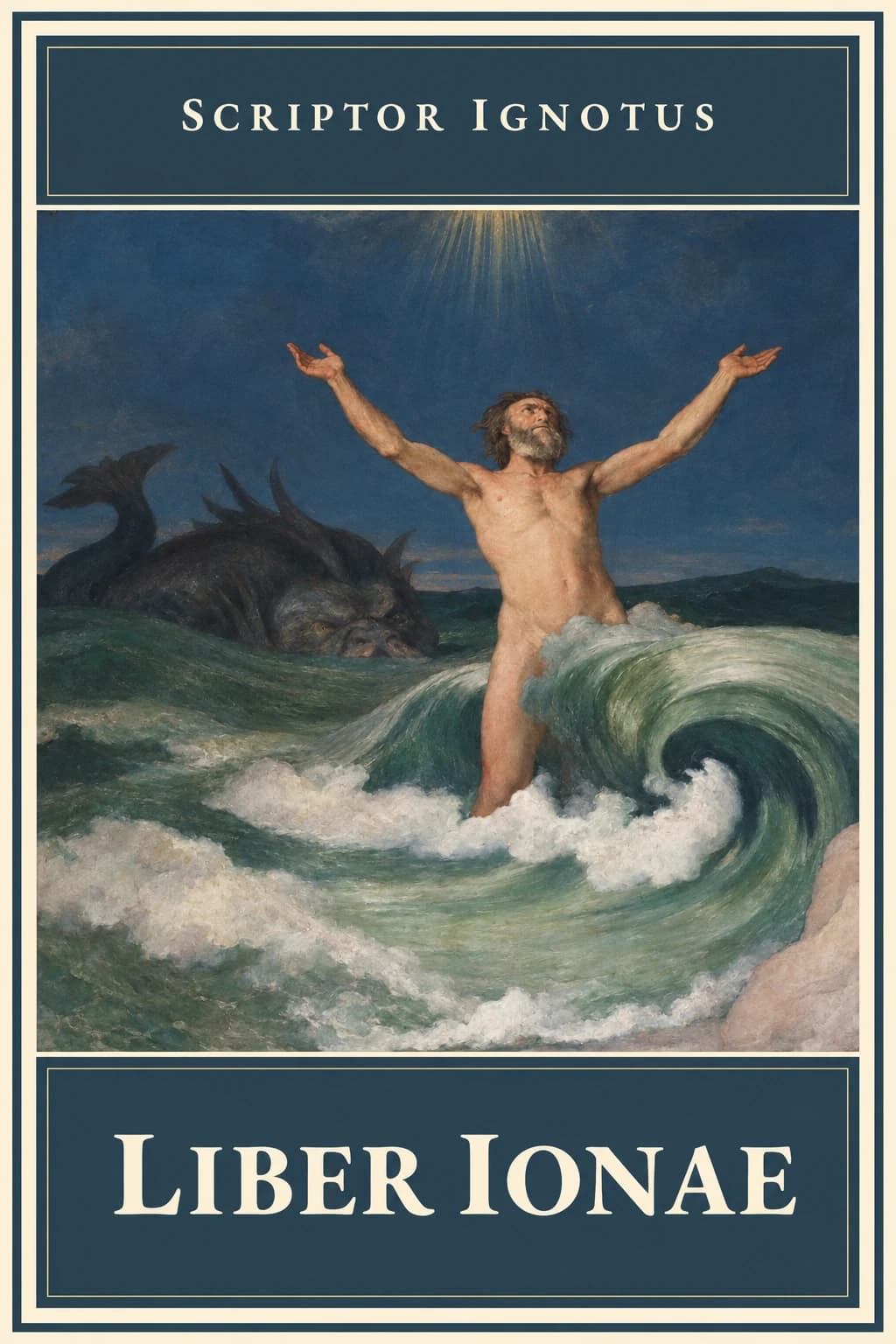
God tells Jonah, the son of Amathi, to go and preach against Nineveh, “the great city.” Jonah runs the other way, on a ship for Tharsis. God sends a storm; the sailors cast lots, the lot falls on Jonah, and at his own word they throw him into the sea, which falls calm. A great fish swallows him, and he is in its belly three days and three nights, praying, until it casts him out on dry land. Sent a second time, he goes to Nineveh and announces that in forty days it will be destroyed. The whole city, from the king down, fasts and repents, and God spares it. Jonah is furious, and God answers him with a question. That is the whole Book of Jonah: 48 verses.
Scene by scene
The story in Latin, in six scenes.
Each scene has its key sentence in the Latin of the Vulgate, with long vowels marked, and the Douay-Rheims English under it. Tap any Latin word for its definition, lemma and form.
1. The call, and the flight
God sends Jonah to Nineveh. Perowne’s note in the reader: “On the E. bank of the Tigris, the capital of the ancient kingdom and empire of Assyria.” Jonah goes down to the coast instead, to Joppe (“Now Jaffa, the well-known port of Palestine on the Mediterranean,” says Perowne), and pays for a passage to Tharsis (“Probably Tartessus, an ancient mercantile city of the Phoenicians, in the S. of Spain”).
Ionas 1:3
Tap a word — or show the glosses under every word.
And Jonas rose up to flee into Tharsis from the face of the Lord, and he went down to Joppe, and found a ship going to Tharsis: and he paid the fare thereof, and went down into it, to go with them to Tharsis from the face of the Lord.Douay-Rheims, Jonas 1:3
2. The storm
Ionas 1:4
Tap a word — or show the glosses under every word.
But the Lord sent a great wind to the sea: and a great tempest was raised in the sea, and the ship was in danger to be broken.Douay-Rheims, Jonas 1:4
The sailors cry to their god and throw the cargo overboard. Jonah is below deck, fast asleep (dormiēbat sopōre gravī), until the shipmaster wakes him: Quid tū sopōre dēprimeris? “Why art thou fast asleep?” (1:6).
3. The lot falls on Jonah
The sailors decide that someone on board has brought this on them, and they cast lots to find out who: et cecidit sors super Iōnam, “and the lot fell upon Jonas” (1:7). Jonah tells them he is a Hebrew, running from the Lord who made the sea, and gives them the only way out.
Ionas 1:12
Tap a word — or show the glosses under every word.
And he said to them: take me up, and cast me into the sea, and the sea shall be calm to you: for I know for my sake this great tempest is upon you.Douay-Rheims, Jonas 1:12
They row hard for land and cannot reach it. They pray not to be charged with innocent blood, and then they throw him in, and “the sea ceased from raging” (1:15).
4. Three days in the great fish
Ionas 2:1 (KJV 1:17)
Tap a word — or show the glosses under every word.
Now the Lord prepared a great fish to swallow up Jonas: and Jonas was in the belly of a fish for three days and three nights.Douay-Rheims, Jonas 2:1
From the belly of the fish Jonah prays: “I cried out of my affliction to the Lord, and he heard me.” The prayer fills the rest of the chapter, and it is quoted in full, in Latin, on the Book of Jonah in Latin. Then dīxit Dominus piscī, et ēvomuit Iōnam in āridam: “the Lord spoke to the fish: and it vomited out Jonas upon the dry land” (2:11).
5. Nineveh repents
The word of the Lord comes to Jonah a second time, and this time he goes. Nineveh is “a great city of three days’ journey.” Jonah walks one day into it and gives his message.
Ionas 3:4
Tap a word — or show the glosses under every word.
And Jonas began to enter into the city one day’s journey: and he cried and said: Yet forty days and Ninive shall be destroyed.Douay-Rheims, Jonas 3:4
Ionas 3:5
Tap a word — or show the glosses under every word.
And the men of Ninive believed in God: and they proclaimed a fast, and put on sackcloth from the greatest to the least.Douay-Rheims, Jonas 3:5
The king leaves his throne, puts on sackcloth and sits in ashes, and orders that neither people nor animals eat or drink. God sees that they have turned from their evil way and spares the city (3:10). A note in the reader, from Haydock’s Bible, puts the lesson plainly: “This and many other menaces are conditional. If man repent, God will change his sentence.”
6. The ivy, the worm, and the question
Jonah is angry. He goes out east of the city, makes himself a shelter and waits to see what will happen. God makes a plant grow over his head for shade (the Latin calls it hedera, ivy), and Jonah is “exceeding glad of the ivy.” At dawn the next day God sends a worm, the plant withers, a hot wind blows, and Jonah asks to die. “I am angry with reason even unto death,” he says (4:9). God’s answer is the last sentence of the book.
Ionas 4:10–11 · the end of the book
Tap a word — or show the glosses under every word.
And the Lord said: Thou art grieved for the ivy, for which thou hast not laboured, nor made it to grow, which in one night came up, and in one night perished. And shall I not spare Ninive, that great city, in which there are more than a hundred and twenty thousand persons, that know not how to distinguish between their right hand and their left, and many beasts?Douay-Rheims, Jonas 4:10–11
Perowne’s note on those who cannot tell right hand from left: “The reference is no doubt to the children of tender age who were as yet incapable of moral discrimination, and could not therefore be regarded as responsible agents.” Jonah’s reply is not recorded. The story stops on the question.
The whale
Was it a whale? What the Latin says.
Not in the Book of Jonah. Its Latin says piscis, “fish,” and the creature is a piscis grandis, a great fish, which God “prepared” (praeparāvit) for the purpose. The Douay-Rheims and the King James Version both translate it “great fish.”
The whale comes from the Gospel of Matthew. When Jesus speaks of Jonah in Matthew 12:40, the Vulgate uses a different word, cētus, a Latin borrowing from Greek for a huge sea creature, and the English translations render it “whale.” Matthew is not in the reader, so here is the verse from the Clementine Vulgate, without glosses:
Sicut enim fuit Jonas in ventre ceti tribus diebus, et tribus noctibus, sic erit Filius hominis in corde terrae tribus diebus et tribus noctibus.
For as Jonas was in the whale’s belly three days and three nights: so shall the Son of man be in the heart of the earth three days and three nights.Douay-Rheims, Matthew 12:40
In both English Bibles, that verse is the only place the story of Jonah has a whale: the King James Version also has “in the whale’s belly” at Matthew 12:40, and “a great fish” at Jonah 1:17.
Why he ran
Why did Jonah run away from God?
The book gives one reason, in Jonah’s own words, and it comes late: only after Nineveh has been spared does he say why he fled.
Ionas 4:1–2
Tap a word — or show the glosses under every word.
And Jonas was exceedingly troubled, and was angry: And he prayed to the Lord, and said: I beseech thee, O Lord, is not this what I said, when I was yet in my own country? therefore I went before to flee into Tharsis: for I know that thou art a gracious and merciful God, patient, and of much compassion, and easy to forgive evil.Douay-Rheims, Jonas 4:1–2
He ran because he expected God to forgive Nineveh. The book never says he hated the city, and gives no other motive. Commentators have filled the gap in different ways. The note on 4:1 in the reader, signed by Challoner in Haydock’s Bible, reads: “His concern was lest he should pass for a false prophet; or rather lest God’s word, by this occasion, might come to be slighted and disbelieved.”
In the Gospels
The sign of Jonah.
Jonah is the prophet Jesus names when he is asked for a sign. In Matthew 12:39 and Luke 11:29 the answer is the same: no sign shall be given “but the sign of Jonas the prophet.” Matthew explains it by the three days in the fish (the verse quoted above) and adds that “the men of Ninive shall rise in judgment with this generation, and shall condemn it: because they did penance at the preaching of Jonas.” Luke puts it in one line:
Nam sicut fuit Jonas signum Ninivitis, ita erit et Filius hominis generationi isti.
For as Jonas was a sign to the Ninivites; so shall the Son of man also be to this generation.Douay-Rheims, Luke 11:30
The name
What does “Jonah” mean?
Jonah is the English form of the Hebrew name Yonah, which means “dove.” The Vulgate gives it as Iōnās (older printings write Jonas, which is the form the Douay-Rheims keeps). Its genitive, Iōnae, “of Jonah,” gives the Latin title of the book, Liber Ionae.
Read it in Latin
A story you can read in the original.
Liber Ionae scores 3.9 on Librorum Capsula’s 1–11 difficulty scale (reviewed), the lowest of any text in the library not written for learners. It is told in short clauses joined by et, the same words keep returning, and every one of them is glossed in the reader. For a chapter-by-chapter guide to the text, Jonah’s prayer in full and the verse numbering, see the Book of Jonah in Latin.
Read next
Liber Ionae
Liber Ionae in the reader: all four chapters of the Vulgate text, with 13 notes from public-domain commentaries.

Evangelium Secundum Marcum
The Gospel of Mark in the same Vulgate Latin, at almost the same level.
Acta Apostolorum
A selection from the Acts of the Apostles, the next step up in biblical Latin.
Sources & further reading
- Liber Ionae as in the reader: Clementine Vulgate Project electronic edition (2005), compared with Wikisource, Vulgata Clementina (revision 146985)
- The Douay-Rheims Bible, revised by Richard Challoner (1749–52): Jonas, as in Project Gutenberg eBook #8337; Matthew 12:39–41 and Luke 11:29–30
- The Clementine Vulgate, Matthew 12:40 and Luke 11:30 (eBible.org); the King James Version, Jonah 1:17 and Matthew 12:40 (Project Gutenberg eBook #10)
- The notes in the reader: T. T. Perowne, Obadiah and Jonah (Cambridge, 1889); Haydock’s notes as abridged by F. C. Husenbeth
- “Jonah (given name),” Wikipedia, for Hebrew Yonah, “dove”