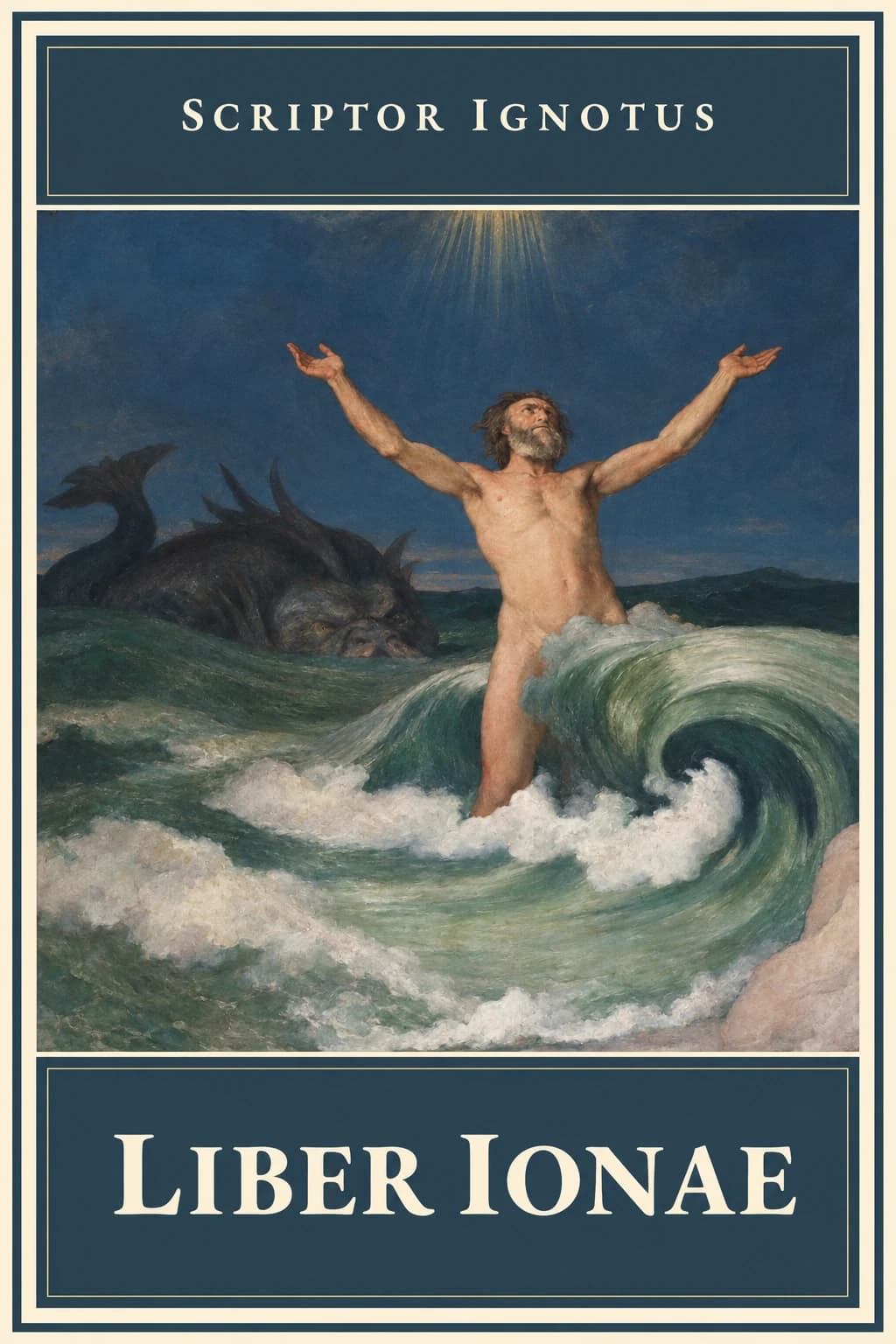
What it is
The Book of Jonah, in Jerome’s Latin.
The Book of Jonah is the fifth of the twelve Minor Prophets, and unlike most prophetic books it is almost all story. God sends Jonah to preach against Nineveh; he takes ship for Tharsis instead; a storm, a casting of lots and a great fish bring him back; Nineveh repents and is spared; and Jonah, angry, is answered with a question. The whole book is 48 verses long.
The Latin is Jerome’s translation from the Hebrew, the version that became the Vulgate. Augustine, writing to Jerome in 403, calls it “the translation taken from the Hebrew,” and the letter is about this very book (see the ivy, below). The text in the reader is the Clementine Vulgate (see the text, below).
Editions title the book in two ways. The reader calls it Liber Ionae, “the book of Jonah.” The Nova Vulgata, the Catholic Church’s revised Latin Bible, and the Latin text on Project Gutenberg call it Prophetia Ionae, “the prophecy of Jonah.” Both are the same book.
The book never names its writer: it tells Jonah’s story in the third person, which is why the reader’s byline is Scriptor Ignotus, “unknown writer.” The prophet appears once outside it, in 2 Kings 14:25 (4 Kings in the Vulgate), as “Jonas the son of Amathi, the prophet, who was of Geth, which is in Opher.”
This is the Latin text, not a translation. The English under each quotation is the Douay-Rheims, the English Bible translated from this Latin, given so you can check your reading. If you want an English Bible, read one; if you want to read what the Vulgate says, word by word, this page and the reader are for that.
Chapter by chapter
The four chapters, in Latin.
Each quotation is the reader’s text, with long vowels marked. Tap a word for its definition, lemma and form, or Show glosses for a word-by-word gloss. Verse numbers are the Vulgate’s; the English is the Douay-Rheims in Challoner’s revision (1749–52), which numbers the verses the same way.
Jonah 1: the call, and the flight
The book opens with a formula familiar from the prophets, et factum est verbum Dominī, “and the word of the Lord came.” Jonah’s answer is to run: down to Joppe and onto a ship for Tharsis, “from the face of the Lord.” A storm follows, the sailors cast lots, the lot falls on Jonah, and when they ask who he is, he answers in a sentence a beginner can read.
Ionas 1:1–2
Tap a word — or show the glosses under every word.
Now the word of the Lord came to Jonas, the son of Amathi, saying: Arise and go to Ninive, the great city, and preach in it: For the wickedness thereof is come up before me.Douay-Rheims, Jonas 1:1–2
Ionas 1:9
Tap a word — or show the glosses under every word.
And he said to them: I am a Hebrew, and I fear the Lord, and the God of heaven, who made both the sea and the dry land.Douay-Rheims, Jonas 1:9
At his own word, the sailors throw him overboard, and “the sea ceased from raging” (1:15). The storm, the lots and the fish are told scene by scene in Jonah and the whale: the story in the Latin Bible.
Jonah 2: the prayer from the belly of the fish
In the Latin, chapter 2 opens with the fish: Et praeparāvit Dominus piscem grandem ut dēglūtīret Iōnam, “Now the Lord prepared a great fish to swallow up Jonas” (2:1). The rest of the chapter is Jonah’s prayer, given here in full. It is the most compressed Latin in the book, and the reader has notes on it from Calvin and Perowne.
Ionas 2:2–10 · Jonah’s prayer (KJV 2:1–9)
Tap a word — or show the glosses under every word.
And Jonas prayed to the Lord, his God, out of the belly of the fish. And he said: I cried out of my affliction to the Lord, and he heard me: I cried out of the belly of hell, and thou hast heard my voice. And thou hast cast me forth into the deep, in the heart of the sea, and a flood hast compassed me: all thy billows, and thy waves have passed over me. And I said: I am cast away out of the sight of thy eyes: but yet I shall see the holy temple again. The waters compassed me about even to the soul: the deep hath closed me round about, the sea hath covered my head. I went down to the lowest parts of the mountains: the bars of the earth have shut me up for ever: and thou wilt bring up my life from corruption, O Lord, my God. When my soul was in distress within me, I remembered the Lord: that my prayer may come to thee, unto the holy temple. They that in vain observe vanities, forsake their own mercy. But I with the voice of praise will sacrifice to thee: I will pay whatsoever I have vowed for my salvation to the Lord.Douay-Rheims, Jonas 2:2–10
The chapter ends as briefly as it began: Et dīxit Dominus piscī, et ēvomuit Iōnam in āridam, “And the Lord spoke to the fish: and it vomited out Jonas upon the dry land” (2:11).
Jonah 3: Nineveh
The word of the Lord comes to Jonah secundō, “the second time,” in almost the same words as before, and this time he goes. His whole message is one short sentence: Adhūc quadrāgintā diēs, et Nīnivē subvertētur, “Yet forty days and Ninive shall be destroyed” (3:4). The people believe it, and the news reaches the king.
Ionas 3:6
Tap a word — or show the glosses under every word.
And the word came to the king of Ninive: and he rose up out of his throne, and cast away his robe from him, and was clothed in sackcloth, and sat in ashes.Douay-Rheims, Jonas 3:6
Perowne’s note on this verse, in the reader: “No greater contrast could well be conceived than between the royal ‘robe’ and ‘sackcloth,’ or between the heap of ‘ashes’ and the king’s ‘throne.’” The king orders that even the animals fast, and God, seeing that they have turned from their evil way, does not do what he had threatened (3:10).
Jonah 4: Jonah’s anger, and God’s question
Jonah is angry that the city has been spared, and says why he ran in the first place: he knew that God is “a gracious and merciful God, patient, and of much compassion, and easy to forgive evil” (4:2). God answers with a question, the first of three.
Ionas 4:4
Tap a word — or show the glosses under every word.
And the Lord said: Dost thou think thou hast reason to be angry?Douay-Rheims, Jonas 4:4
Jonah goes out to the east of the city to watch what will happen. God makes a plant grow over him for shade, sends a worm to kill it, and asks the same question about the plant (4:9). Then the book ends on God’s last question, about Nineveh and its “more than a hundred and twenty thousand persons, that know not how to distinguish between their right hand and their left.” That sentence is quoted in full on the story page.
Verse numbers
Why Jonah 1:17 is 2:1 in Latin.
Latin and English Bibles put the line between chapters 1 and 2 in different places. In the Vulgate, and so in the Douay-Rheims, chapter 1 has 16 verses and chapter 2 begins with the great fish. In the King James Version the fish is the last verse of chapter 1. Chapters 3 and 4 are numbered the same in both.
- Vulgate 1:1–16 = KJV 1:1–16: the call, the flight, the storm.
- Vulgate 2:1 = KJV 1:17: the great fish swallows Jonah.
- Vulgate 2:2–10 = KJV 2:1–9: Jonah’s prayer.
- Vulgate 2:11 = KJV 2:10: the fish casts him out on dry land.
- Vulgate 3–4 = KJV 3–4: no difference.
So if you are looking for “Jonah 2” in a Latin Bible, the prayer starts at 2:2.
One word
Hedera: the ivy that caused a riot.
In chapter 4 God makes a plant grow over Jonah’s head for shade. The King James Version calls it a gourd. Jerome’s Latin calls it hedera, “ivy,” and the Douay-Rheims follows him.
Ionas 4:6
Tap a word — or show the glosses under every word.
And the Lord God prepared an ivy, and it came up over the head of Jonas, to be a shadow over his head, and to cover him (for he was fatigued): and Jonas was exceeding glad of the ivy.Douay-Rheims, Jonas 4:6
That one word nearly cost a bishop his congregation. Writing to Jerome in 403, Augustine reports that a bishop in the African town of Oea had Jerome’s new translation read in church, and came to a word in Jonah rendered differently from the version everyone knew: “Thereupon arose such a tumult in the congregation, especially among the Greeks, correcting what had been read, and denouncing the translation as false, that the bishop was compelled to ask the testimony of the Jewish residents.” They sided with the old version, and in the end “the man was compelled to correct your version in that passage as if it had been falsely translated, as he desired not to be left without a congregation.”
Augustine did not say which word it was. Jerome guessed at once: “Perhaps it is the old dispute about the gourd.” The Septuagint, he explains, has gourd, Aquila and the others have ivy, and the Hebrew has ciceion, a fast-growing shrub with large leaves. Putting the Hebrew word itself would have meant nothing to a Latin reader, he says, and gourd would have been “what is not found in the Hebrew.” “I therefore put down ivy, that I might not differ from all other translators.”
The question was still open when the Douay-Rheims was revised. The note on this verse in Challoner’s Douay-Rheims reads: “Hederam. In the Hebrew it is Kikajon, which some render a gourd: others a palmerist, or palma Christi.”
The text
The Clementine Vulgate.
The Latin is the Clementine Vulgate as published in the Clementine Vulgate Project’s electronic edition (2005, public domain), derived principally from the Colunga and Turrado text (Madrid, 1946) with consultation of the Vercellone (1861) and Hetzenauer (1914) editions. It agrees on all 967 words, and on punctuation and capitals, with the independent Wikisource transcription of the Vulgata Clementina (revision 146985). It has not been collated against a printed edition or page images.
The spelling is the Clementine text’s, with i for j (so Iōnās, not Jonas) and long vowels marked as a separate layer. Five occurrences of two names, Amathi once and Tharsis four times, are left unmarked, because no source consulted gives their vowel lengths.
How hard is the Latin?
An easy first book of Latin scripture.
Liber Ionae scores 3.9 on Librorum Capsula’s 1–11 difficulty scale (reviewed), the lowest of any text in the library not written for learners. For comparison, the Gospel of Mark scores 4.0, the Acts of the Apostles 4.4 and Paul’s letters to the Corinthians 5.0. The story is told in short clauses joined by et, with common vocabulary that keeps coming back: surge, mare, cīvitās magna, ā faciē Dominī. The prayer in chapter 2 and the book’s last sentence are the two hard places.
How to read it
The call, the flight and the storm are the plainest Latin in the book, and the words you meet here return in every chapter.
Chapter 2 is two sentences of story around a prayer. Tap the unfamiliar words; the notes explain the temple and “their mercy.”
Nineveh’s repentance and Jonah’s anger are one movement, and chapter 4 answers chapter 3.
The book’s longest sentence is its ending, and the question it asks is the point of the book.
Read next
Evangelium Secundum Marcum
The Gospel of Mark in the same Vulgate Latin, a fast narrative at almost the same level.
Acta Apostolorum
A selection from the Acts of the Apostles, the next step up in biblical Latin.
Ad Corinthios I & II
Paul’s letters to the Corinthians, where the sentences become arguments. See also the guide to 1 Corinthians in Latin.
Sources & further reading
- Clementine Vulgate Project, electronic edition of the Vulgata Clementina (2005), from the Colunga and Turrado text (Madrid, 1946), read from Bible Gateway’s Biblia Sacra Vulgata; compared with Wikisource, Vulgata Clementina, Liber Ionae (revision 146985)
- “Book of Jonah,” Wikipedia, for its place among the Minor Prophets
- Nova Vulgata, Prophetia Ionae (vatican.va), and Prophetia Ionae (Project Gutenberg eBook #4317), for the title
- The Douay-Rheims Bible, revised by Richard Challoner (1749–52), Jonas, with the note on 4:6, as in Project Gutenberg eBook #8337; 4 Kings 14:25 from the same translation
- The King James Version, Jonah 1:17 and 4:6, for the English numbering and “gourd” (Project Gutenberg eBook #10)
- Augustine, Letter 71, to Jerome (403), and Jerome’s reply, Letter 75 in Augustine’s letters (112 in Jerome’s), in the Nicene and Post-Nicene Fathers translation (Letter 71, Letter 75)
- The notes in the reader: T. T. Perowne, Obadiah and Jonah (Cambridge, 1889); Haydock’s notes as abridged by F. C. Husenbeth; Calvin’s commentary on Jonah, tr. John Owen (1847); Matthew Henry’s Exposition (1860)