What it is
What is Pliny 7.27?
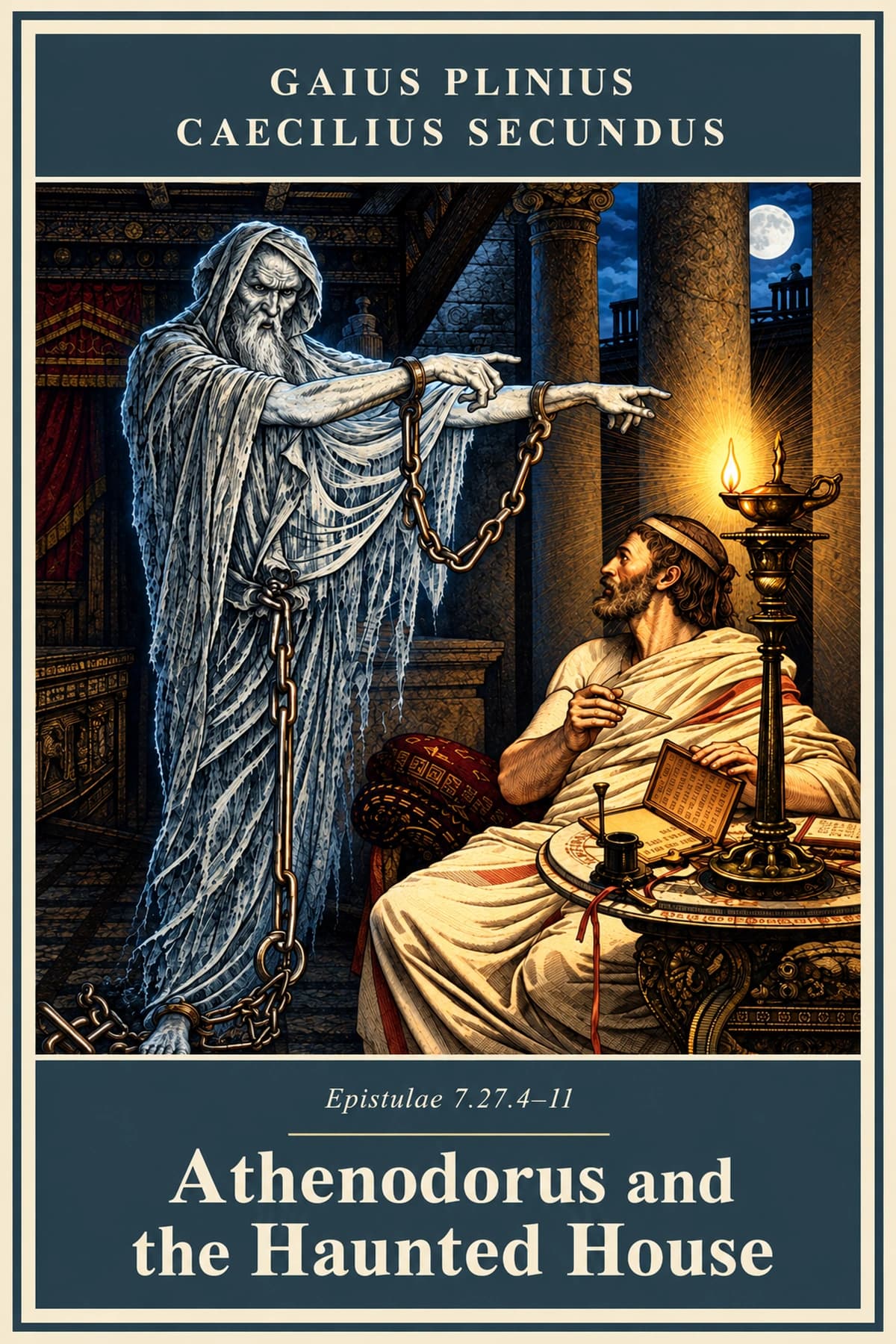
Letter 7.27 of Pliny the Younger’s Epistulae is addressed to his friend Sura. Pliny asks him a direct question: do ghosts really exist, or are they images produced by fear? To make the question harder to wave away, he tells three supernatural stories. The longest is the haunted house at Athens and the philosopher Athenodorus (7.27.4–11). It is one of the Pliny letters in the revised AP Latin selection.
A large house in Athens has become impossible to live in: every night a chained, emaciated ghost walks it, and its occupants flee or die. The philosopher Athenodorus, wary of the low rent, rents it anyway and waits up to see for himself. What he finds, and what he does about it, is the rest of the story, in 304 words of Latin.
From the story
Erat Athēnīs spatiōsa et capāx domus: the first sentence.
The story opens plainly, and Librorum Capsula helps you with any word you don’t know:
Pliny the Younger · Epistulae 7.27
Tap a word — or reveal the translation.
A later moment
Stābat innuēbatque: the ghost beckons.
Later in the night, one short sentence carries a whole scene. Tap vocantī to see how a participle can stand for a person:
Pliny the Younger · Epistulae 7.27
Tap a word — or reveal the translation.
Key vocabulary
Words you will meet in Pliny 7.27.
A few of the rarer words, with the meanings they have in this story. In the reader, every one of the 304 words has its own definition, lemma and form.
- compēs, -edis (f.): fetters
- squālor, -ōris (m.): filth
- pugillārēs, -ium (m. pl.): writing tablets
- innuō, -ere: beckon, nod
- ārea, -ae (f.): courtyard
- effodiō, -ere: dig up
- mānēs, -ium (m. pl.): the spirits of the dead
How hard is the Latin?
The gentlest way into Pliny.
It scores 5.6 on Librorum Capsula’s 1–11 difficulty scale (reviewed): Intermediate. That makes it the gentlest way into Pliny in the catalog. The AP Pliny selection as a whole scores 6.1 and the Vesuvius letters 6.7. The opening is easier (5.0). The hardest stretch (7.0) is the night itself: a run of historical infinitives with no stated subjects and no conjunctions.
About a third of the sentences are short and plain. The rest of the difficulty is vocabulary: words like compedēs, squālor, pugillārēs and putrefactum are rare outside this story. A definition on every word helps most here.
The whole letter
What else is in letter 7.27.
The haunted house is the centrepiece, but it isn’t the whole letter.
- 7.27.1: Pliny puts the question to Sura: are ghosts real?
- 7.27.2: a story about Curtius Rufus and a visitor in Africa.
- 7.27.4–11: Athenodorus and the haunted house.
- 7.27.12–14: a story from Pliny’s own household, and what he made of it.
- 7.27.15–16: his request that Sura weigh in, one side or the other.
The haunted-house reader holds 7.27.4–11. The AP Pliny reader holds the complete letter, 7.27.1–16.
In the reader
The whole episode, with every word defined.
The reader has the whole haunted-house episode, 7.27.4–11: 304 words in 22 sentences. The text is the Dickinson College Commentaries edition (ed. Ashley Roman Francese), checked against the printed page of S. B. Platner’s 1894 Selections from the Letters of the Younger Pliny. Long vowels are marked throughout. Every word has a definition, lemma and form, each checked by hand, and thirteen short notes come from the classic school commentaries of Merrill, Wescott, Kingery and Allen.
Read next
Pliny 6.16 and 6.20 in Latin → · Pliny’s Letters in Latin →
Epistulae de Vesuvii Eruptione
Pliny’s two letters to Tacitus on the eruption of Vesuvius in AD 79. Harder, and just as vivid.
Pliny the Younger's Letters
The complete ghost letter, alongside the other nine required Pliny letters.
Sources & further reading
- Dickinson College Commentaries, Pliny, Epistulae 7.27 (ed. Ashley Roman Francese), used under CC BY-SA
- S. B. Platner, Selections from the Letters of the Younger Pliny (Boston, 1894)
- E. T. Merrill, J. H. Wescott, H. M. Kingery and G. B. Allen, school editions of Pliny’s selected letters (commentary notes)