Fable one
The Toad and His Son.
The animals are holding a council. A toad has sent his son, but forgot to give him his new shoes, so he looks for a fast messenger and hires a hare. The hare asks how he will recognise the toad’s son in a crowd:
Two Medieval Fables · The Toad and His Son
Tap a word — or show the glosses under every word.
The toad said, “The one who is the most beautiful among all the animals is my son.”
Is it the dove, asks the hare, or the peacock? No, says the toad: the dove has black eyes and the peacock ugly feet. My son has a head like mine, a belly like mine, legs like mine. The fable ends with a verdict and a proverb:
Two Medieval Fables · The Toad and His Son
Tap a word — or show the glosses under every word.
If someone loves a frog, he thinks the frog is Diana.
Fable two
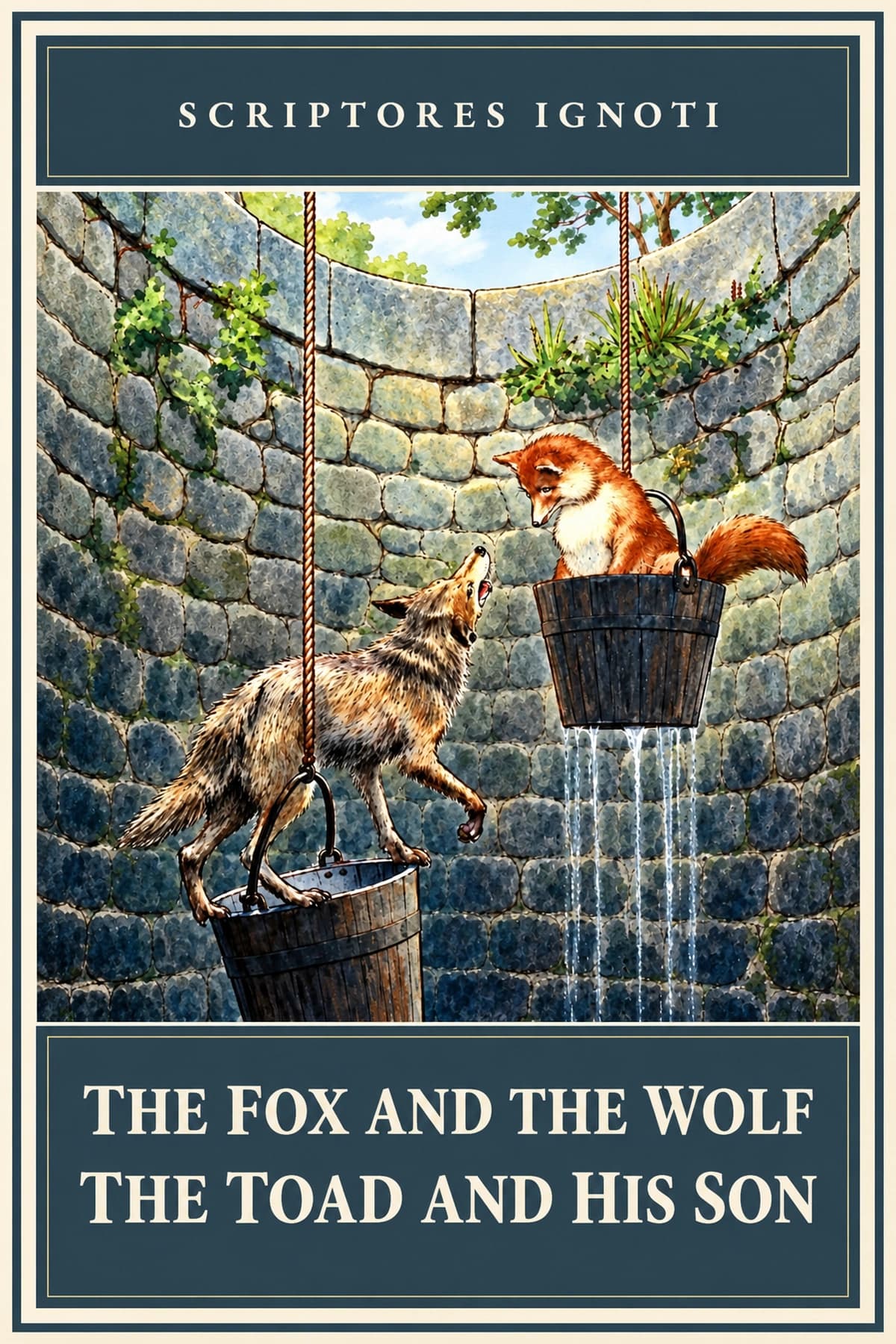
The Fox and the Wolf.
A fox has fallen into a well in a bucket. When the wolf comes by and asks what she is doing, she says the well is full of fish, and wishes he were here to share them. There are two buckets, one going up as the other goes down:
Two Medieval Fables · The Fox and the Wolf
Tap a word — or show the glosses under every word.
The little fox said, “One bucket is left: put yourself in it, and you will come down.”
The wolf gets into the bucket and goes down; the fox, in the other, goes up. As they pass, he asks where she is going, and she says she has eaten enough and he will find marvels below. The ending is short:
Two Medieval Fables · The Fox and the Wolf
Tap a word — or show the glosses under every word.
The poor wolf went down, and found nothing but water. In the morning the peasants came, pulled the wolf out, and beat him to death.
The wolf is called Ysengrinus here, a name from the Romance of Reynard, as Thomas Wright points out in a note the reader prints.
How hard is the Latin?
Short, funny and mostly dialogue.
The two fables score 4.3 on Librorum Capsula’s 1–11 difficulty scale. Each is a single short paragraph of narrative and speech. What to watch for:
- Medieval spelling. The reader follows the catalog convention (i for j, ae for the printed ligature), so the Latin is easy to look up.
- Unusual words. sotulārēs (shoes) and compater (literally “co-father”, used here for a close friend, as the fox calls the wolf) are medieval; both are defined.
- Names. The wolf is Ysengrīnus, a name from the Reynard stories, and the reader leaves one vowel in it unmarked because its length is not settled.
If medieval Latin is new to you, see our guide to Medieval Latin.
In the reader
Both fables, with every word defined.
The reader has both fables from Thomas Wright’s 1842 Selection of Latin Stories (numbers LVI and LVII, printed pp. 53–54), checked against page images of the Internet Archive scan, with two of Wright’s notes quoted word for word. Every word has a definition, lemma and form. Display text is macronized as an editorial layer, and four word occurrences are left with an unsettled vowel length.
Read next
The Island That Moved
Saint Brendan’s monks light a fire on an island that turns out to be alive.
Jovinian the Proud Emperor
A proud emperor loses his name in a single morning.
Disciplina Clericalis
Petrus Alfonsi’s book of tales, including a fox who tricks a wolf, in plain Latin.
Sources & further reading
- Thomas Wright (ed.), A Selection of Latin Stories from Manuscripts of the Thirteenth and Fourteenth Centuries (London: Percy Society, 1842), nos. LVI and LVII and notes pp. 228–229