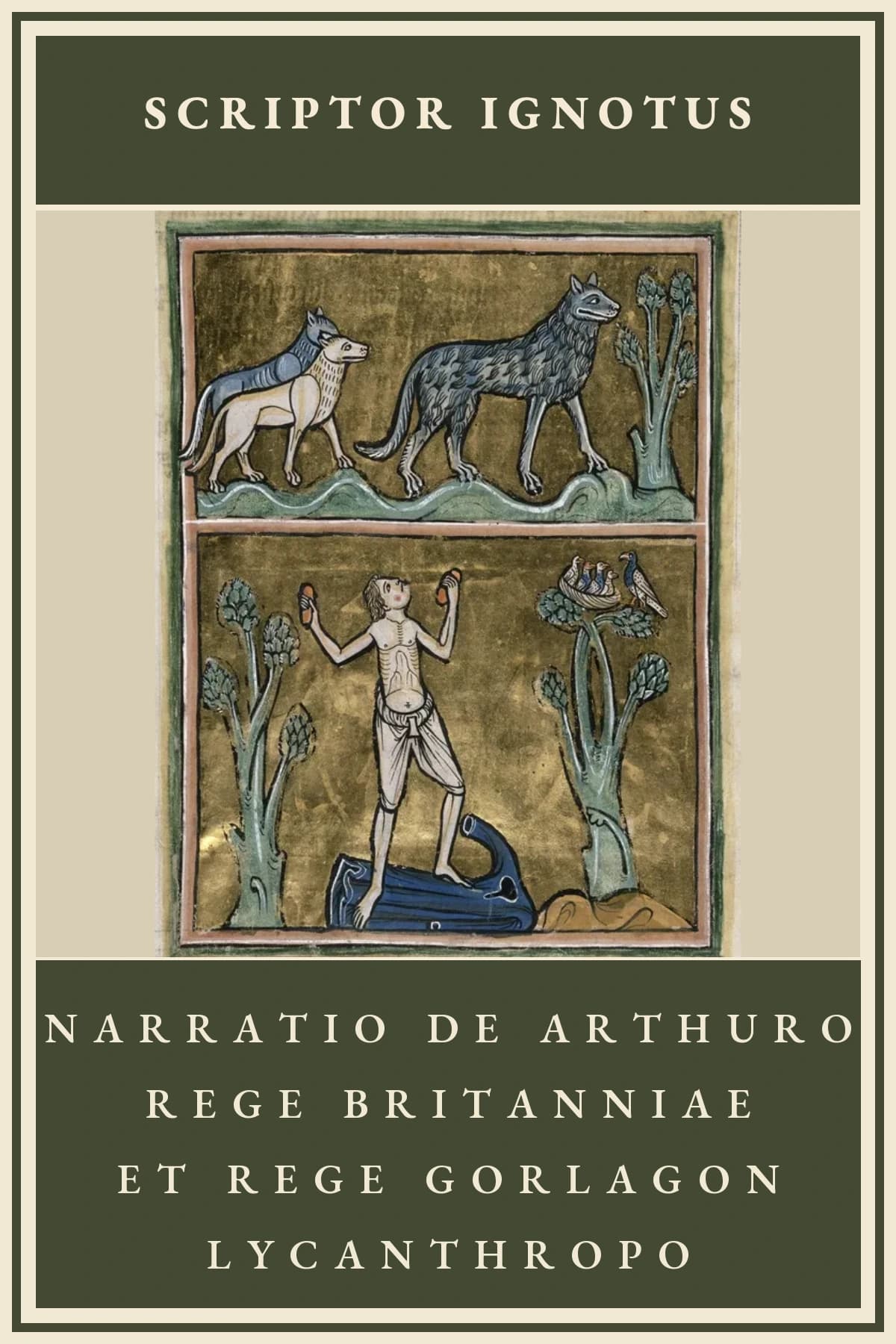
The frame
Arthur boasts, and the queen disagrees.
King Arthur is holding Pentecost at the City of the Legions. At the feast he throws his arms around the queen in front of everyone, and when she asks why, he says that nothing is dearer to him. If you love me so much, she says, you think you know my mind. Arthur says he is sure he does. She answers:
Arthur and Gorlagon
Tap a word — or show the glosses under every word.
Arthur, you are surely mistaken; you would find that you have never discovered the nature or the mind of a woman.
Arthur is stung, and swears an oath:
Arthur and Gorlagon
Tap a word — or show the glosses under every word.
I call on all the powers of heaven: if these things have so far been hidden from me, I will make the effort, and, sparing no labour, I will never enjoy food until I come to know them.
The quest
Three brothers, and a refusal to eat.
Arthur leaves with Kai and his nephew Gawain. The first king he asks, Gorgol, says what he wants is a great matter that few understand, and sends him to his older brother Torleil. Torleil does not know either, and sends him to the third brother, the oldest, King Gorlagon. At each court Arthur refuses to sit down to eat until he has what he came for, and each king persuades him in the end. Torleil’s answer begins with a line that Gorgol and Gorlagon repeat in almost the same words:
Arthur and Gorlagon
Tap a word — or show the glosses under every word.
Arthur, what you are seeking is a great matter, and few are those who understand it.
The werewolf’s story
A king, a branch and a curse.
Gorlagon tells of a king he knew well, noble, rich and famous for justice. In his garden grew a tall branch that had sprung from the earth on the night and hour of the king’s birth, and its fate was fixed:
Arthur and Gorlagon
Tap a word — or show the glosses under every word.
It was fated of this branch that whoever cut it and struck his own head with its slender end, saying ‘Be a wolf, and have a wolf’s mind!’, would at once become a wolf and have a wolf’s mind.
The king guarded it carefully, because his well-being hung on it. But when his unfaithful wife learns the secret, she cuts the branch and strikes him with it, leaving him a wolf who keeps his human intelligence. The story that follows mixes fairy-tale magic with adultery, vengeance, violent deaths and, in the end, the wolf’s return to human form. Its last turn brings the frame and the werewolf story together.
Where it fits
A rational werewolf in an Arthurian frame.
The tale belongs to the same medieval tradition as Marie de France’s Bisclavret and the Lai de Melion, in which a werewolf keeps his human mind, and its framing narrative is unusually elaborate for a Latin text. The reader follows Kittredge’s 1903 edition of the Bodleian manuscript, with the Latin on pp. 150–162.
How hard is the Latin?
Long rhetorical sentences, short speaker labels.
Arthur and Gorlagon scores 6.0 on Librorum Capsula’s 1–11 difficulty scale: Intermediate, and a little easier than Caesar’s De Bello Gallico I (6.3). What to watch for:
- Long sentences. The narrator sometimes strings participles and subordinate clauses across several lines.
- Speaker labels. Speeches are introduced with a name on its own line (Arturus., Rēgīna.), which makes dialogue easy to follow.
- Medieval spelling. Forms such as hēc for haec and nichil for nihil are kept as printed.
If medieval Latin is new to you, see our guide to Medieval Latin.
In the reader
The whole tale, with every word defined.
The reader has the complete Latin text, about 4,400 words, from George Lyman Kittredge’s 1903 edition (Boston: Ginn & Company), collated against the page images of two copies with no textual discrepancies. Every word has a definition, lemma and form, and long vowels are marked.
Read next
Gerald and the Werewolves
Gerald of Wales and the werewolves of Ossory.
A Witch's End
A witch tries to protect her corpse from the demons she served.
Vera Historia De Morte Arthuri
An anonymous medieval Latin account of Arthur’s last battle and death.
Sources & further reading
- George Lyman Kittredge, Arthur and Gorlagon (Boston: Ginn & Company, 1903), Latin text pp. 150–162, from Oxford, Bodleian Library, MS Rawlinson B.149