The story
The devil against a young nun.
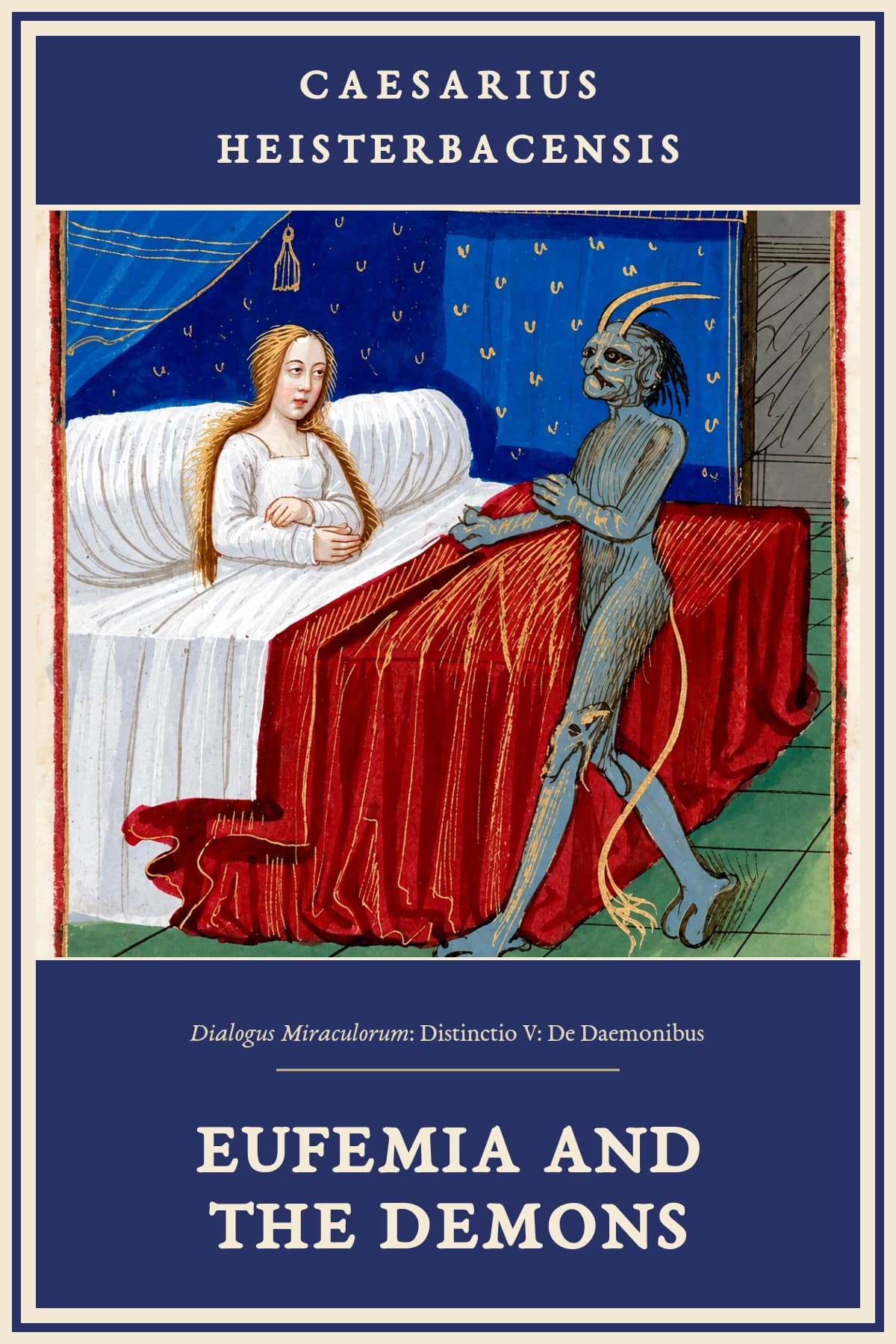
As a small child, Eufemia sees the devil again and again, in different shapes. Afraid she will go mad, she resolves to enter religious life. One night the devil comes to her as a man and tries to talk her out of it: marry a handsome young man and enjoy the world’s pleasures; in the convent you’ll be ragged, hungry and cold for ever. She answers with a question:
Caesarius of Heisterbach · Dialogus miraculorum V.44
Tap a word — or reveal the translation.
And what will become of me if I die among those pleasures you promise me?
He has no answer. He snatches her up and carries her to the window of the upper room to throw her out, but she says the Hail Mary and he lets her go. If you go to the cloister, I’ll always be against you, he says. If you hadn’t called on that woman just now, I’d have killed you. Then he crushes her, turns into a huge dog, and leaps out of the window.
She becomes a nun anyway, and the attacks continue:
- Demons round her bed. One night she lies awake and sees demons in the shape of men: one, hideous, at her head, two at her feet, one at her side. Take her just as she lies, one of them shouts. We can’t, the others answer. She called on that woman. One drags her by the right arm and grips it until it swells and bruises. She is afraid a sign of the cross made with her left hand won’t count, but at last she makes it anyway, and the demons flee. She runs, half dead, to a sister’s bed, breaking the night silence.
- Demons disguised as nuns. A year later, two demons come to her in the night looking like two of her dearest sisters: Get up, Sister Eufemia, come to the cellar with us and draw the beer for the community. The hour and the broken silence make her suspicious, so she pulls the covers over her head and says nothing. One presses on her chest until blood pours from her mouth and nose, and they leap from the window in the shape of dogs.
- The visitor in the dormitory. When the convent builds a new dormitory, she sees a demon like a small, deformed old man go round touching every bed, as if to say: I’ll mark each place; none of them will be free of my visits.
Told as a dialogue
A monk tells, a novice asks.
The Dialogus miraculorum is written as a conversation between a monk, who tells the stories, and a novice, who asks questions. Here the novice asks why the demons called the Virgin only “that woman”, and the monk answers that they were too unworthy to say her name. At the end the novice asks the obvious question: why would God let demons torment a girl so young and innocent? The monk’s answer: a bitter cup tasted first makes the sweet sweeter.
Who told Caesarius?
The abbess of her own convent.
Caesarius names his source: the lady Elizabeth, abbess of Eufemia’s own convent, now dead, who told him the story herself, including how the sisters put Eufemia back to bed and read the beginning of St John’s Gospel over her. The editor’s index places Eufemia at the convent of Hoven (a note in the reader).
What the Latin is like
Clear, direct, fast.
It scores 5.9 on Librorum Capsula’s 1–11 scale (reviewed): Intermediate, opening at 5.4 and peaking at 6.6. Caesarius writes clear, direct medieval prose, with plenty of speech and short exchanges, and the story moves fast. It’s a good first long medieval text.
In the reader
The whole chapter, with every word defined.
The whole chapter, Dialogus miraculorum Distinctio V (on demons), chapter 44, from Joseph Strange’s edition (1851): 676 words. Long vowels are marked throughout, every word has a definition, lemma and form, and four short notes come from Strange’s index and notes, the 1605 Antwerp edition and a seventeenth-century commentator.
Read next
Roman ghost stories and Latin horror stories →
The Knight Who Wanted to See a Demon
A sceptic who asks to see demons for himself.