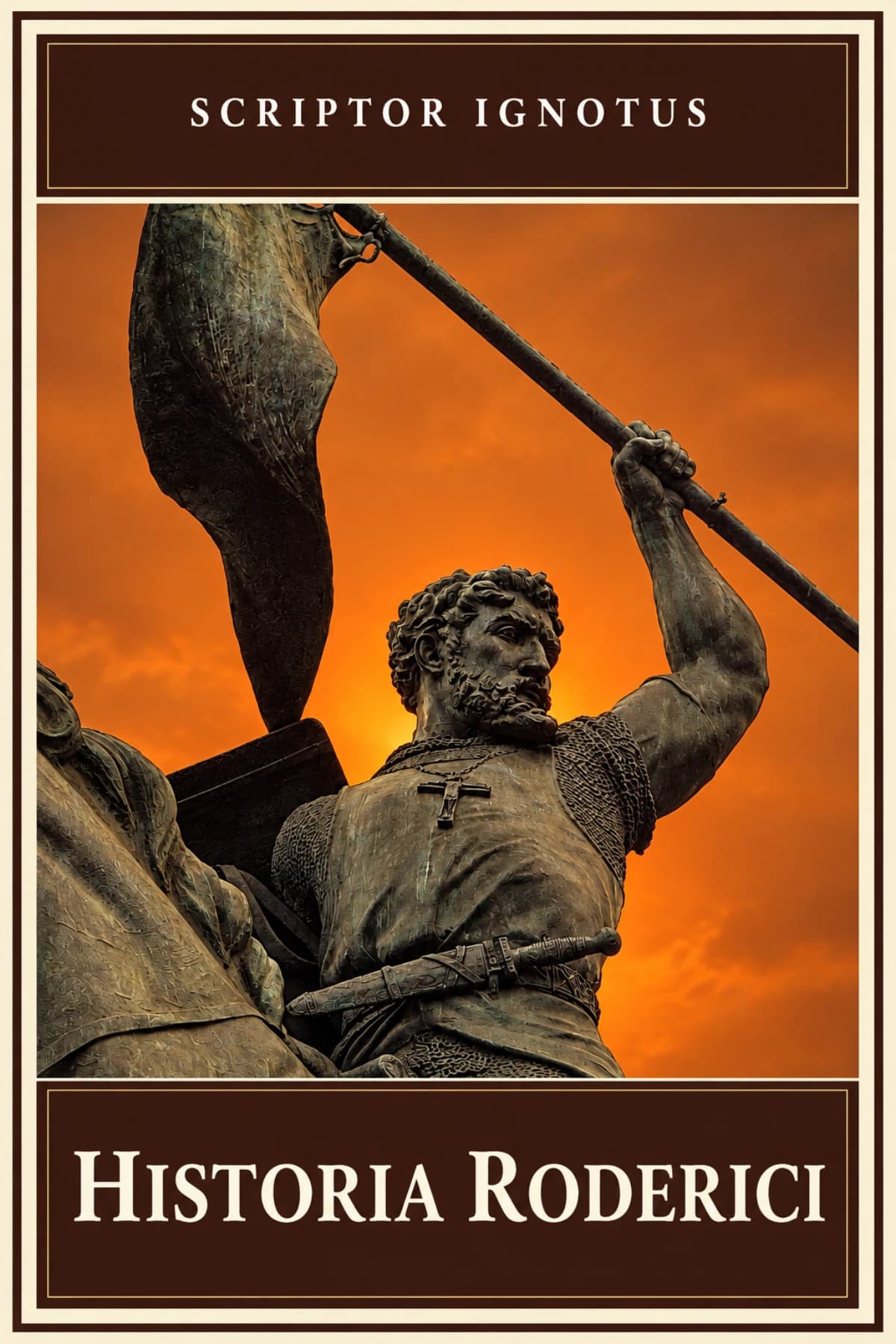
What it is
What is the Historia Roderici?
The Historia Roderici, “the history of Rodrigo”, is an anonymous Latin life of Rodrigo Díaz de Vivar, the Castilian warrior known as El Cid. Its author opens by saying why he writes: the deeds of the past are forgotten unless they are set down, so Rodrigo’s lineage and wars should be kept sub scrīptī lūce, “in the light of writing”. In the manuscripts it is called the Gesta Roderici Campidocti; campidoctus, “skilled in the field”, is the Latin for the title Spanish knows as Campeador.
It is not the Cantar de mio Cid. The Cantar is an Old Spanish epic; the Historia is a plain Latin record of campaigns, alliances and betrayals, and the earliest full account of the historical man.
The story
From Castile to Valencia, in fifteen sections.
- Sections I–IV: the author’s preface, Rodrigo’s ancestors, his youth in the army of Sancho II, and his marriage to Jimena under Alfonso VI.
- Section V: envious courtiers turn the king against him, and Alfonso drives him out of the kingdom. He goes to Barcelona, then into the service of the Muslim kings of Zaragoza.
- Sections VI–VIII: campaigns for Zaragoza against Aragon and Barcelona, and Rodrigo’s first move on Valencia.
- Sections IX–XII: his quarrel and sworn defence before Alfonso, the war of letters with Count Berenguer of Barcelona and the battle that follows, the coming of the Almoravids from North Africa, and the storming of Valencia.
- Sections XIII–XV: Rodrigo holds Valencia: new campaigns, the mosque made a church of Saint Mary, and his death.
The exile
“He came to Barcelona, leaving his friends in sorrow.”
Rodrigo raids the Muslim lands around Toledo while the king is away. The courtiers tell Alfonso that he did it to get them all killed, and the king, “unjustly moved” (iniūstē conmōtus), throws him out of the kingdom:
Historia Roderici V
Tap a word — or show the glosses under every word.
He left the kingdom of Castile and came to Barcelona, leaving his friends in sorrow.
That word iniūstē is typical: the author is on Rodrigo’s side throughout, and says so.
The war of letters
Count Berenguer: “the very Rodrigo whom they call Campeador”.
Section X is the most vivid part of the book. Before their battle, Berenguer, Count of Barcelona, sends Rodrigo a letter full of insults: he says Rodrigo trusts more in the omens of birds than in God (plūs cōnfīdis in auguriīs eōrum quam in Deō), and dares him to come down from his mountain and fight on the plain:
Historia Roderici X · Berenguer’s letter
Tap a word — or show the glosses under every word.
But if you come out to us on the plain and leave your mountain, you will be the very Rodrigo whom they call warrior and Campeador.
Rodrigo answers in kind, and both letters are given in full. Then comes the battle, the count’s capture, and the ransom.
The end
Rodrigo’s death at Valencia, “in the era 1137”.
Historia Roderici XV
Tap a word — or show the glosses under every word.
As long as he lived in this world, he always won a splendid victory over the enemies who fought him, and he was never defeated by anyone. Rodrigo died at Valencia in the era 1137, in the month of July.
The date is given in the Spanish era, which counts from 38 BC, so the era 1137 is AD 1099. The victory over the Almoravids outside Valencia is dated the same way, era 1132 (AD 1094). Expect these dates, written in Roman numerals, throughout the book.
How hard is the Latin?
Plain medieval prose, and a great many names.
The Historia Roderici scores 5.8 on Librorum Capsula’s 1–11 difficulty scale (reviewed): Intermediate, close to the Gesta Francorum (5.7) and easier than Caesar’s De Bello Gallico I (6.3). Sentences are mostly joined with autem, vērō and igitur, and the story is told in a row of participles and main verbs. What makes it harder:
- Medieval spelling. e for ae (Castelle, sue cūrie), c and t interchanged (trīsticia, provintia), and a printed capital V for U.
- Names. Castilian nobles, Catalan counts and the Muslim kings of Zaragoza and Valencia (Almuctaman, Alcadir), often in Latinised forms. Every one is glossed.
- Learned labels. The author calls the Almoravids moabitae, “Moabites”, after a people of the Bible; a note in the reader explains it.
If medieval Latin is new to you, see our guide to Medieval Latin.
In the reader
All fifteen sections, with every word defined.
The reader has the complete Historia Roderici, about 12,400 words, from Adolfo Bonilla y San Martín’s 1911 edition of the Gesta Roderici Campidocti. Every word has a definition, lemma and form. Long vowels are marked on about 93 percent of the words; the rest, mostly personal and place names with no settled vowel lengths, are left unmarked. Where the printed text is doubtful, the reader records the problem instead of silently correcting it.
Read next
Gesta Francorum
The First Crusade, told by an anonymous soldier in the same plain style, at nearly the same level.
Commentarii de Bello Gallico: Liber I
Caesar’s own account of his war in Gaul: classical Latin, longer sentences, more indirect speech.
Vera Historia De Morte Arthuri
An anonymous medieval Latin account of Arthur’s last battle and death.
Sources & further reading
- Adolfo Bonilla y San Martín (ed.), Gestas del Cid Campeador (Gesta Roderici Campidocti) (Madrid: Victoriano Suárez, 1911)
- Emma Falque Rey (ed.), Historia Roderici, in Chronica Hispana saeculi XII, Pars I (Corpus Christianorum Continuatio Mediaevalis 71, 1990)
- Simon Barton and Richard Fletcher (trans.), The World of El Cid: Chronicles of the Spanish Reconquest (Manchester University Press, 2000), with an English translation