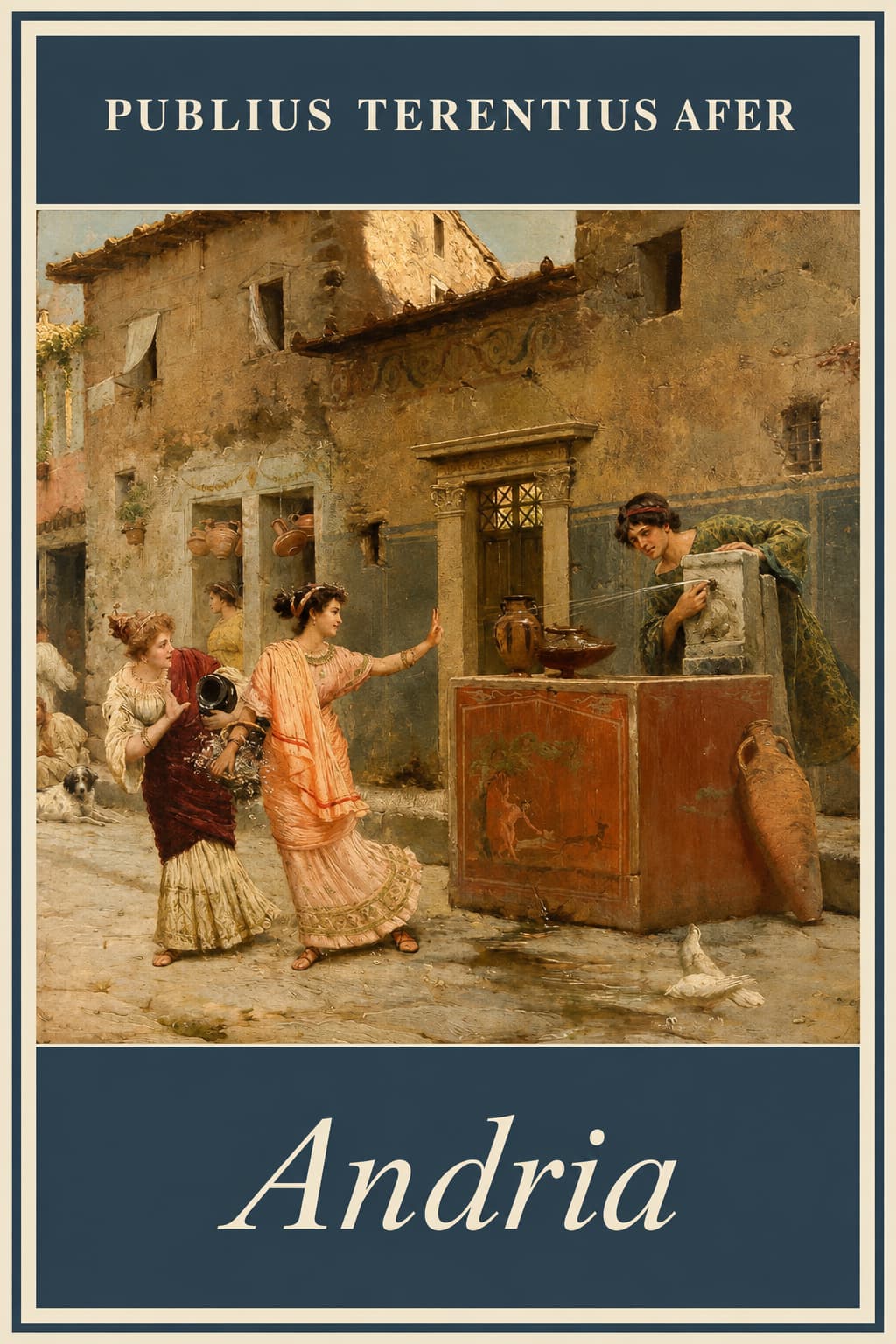
What it is
The Woman of Andros.
Andria, “The Woman of Andros”, was Terence’s first comedy and is one of the clearest introductions to Roman comic drama. It follows Pamphilus, whose father Simo wants him to marry the daughter of a family friend, although Pamphilus is already devoted to Glycerium. The clever slave Davus tries to help; Simo, who suspects everything, keeps changing his approach. Terence is less interested in farce than in character, conversation and the tensions inside families.
The prologue
Terence answers his critics.
A Roman comedy opens with a prologue, and Terence uses his to defend himself. He names his Greek models and says what he did with them:
Terence · Andria, prologue
Tap a word — or show the glosses under every word.
What suited the Andria from the Perinthia, he admits he transferred, and used as his own.
Critics said that mixing two Greek plays this way ruined them. Terence says that he does only what Naevius, Plautus and Ennius did before him.
Lines to know
“I’m Davus, not Oedipus.”
The play has some of the most quoted lines in Terence. Early on, one speaker sums up how the world works: flattery wins friends and truth makes enemies:
Terence · Andria, Act I
Tap a word — or show the glosses under every word.
He has arranged his life wisely; for in these times obsequiousness wins friends, and truth breeds hatred.
Davus, asked to make sense of Simo’s hints, says he is not the man for riddles:
Terence · Andria, Act I
Tap a word — or show the glosses under every word.
No: I am Davus, not Oedipus.
Later, a quarrel between lovers is waved away with another quotable line:
Terence · Andria
Tap a word — or show the glosses under every word.
Just so, I tell you: the quarrels of lovers are the renewal of love.
Near the end Pamphilus says openly what he had been hiding from his father:
Terence · Andria, Act V
Tap a word — or show the glosses under every word.
I admit that I love her; if that is a fault, I admit that too.
How hard is the Latin?
Short, idiomatic and conversational.
The Andria scores 5.4 on Librorum Capsula’s 1–11 difficulty scale: Intermediate, and easier than Caesar’s De Bello Gallico I (6.3). What to watch for:
- Colloquial Latin. Terence uses everyday speech: stock curses (in malam rem), exclamations and sentences cut off mid-thought. The reader explains these in notes.
- Early spellings. Forms such as quom for cum and istuc, and clipped endings such as Dāvo’, show up often.
- Verse. The lines are metrical, but the reader does not require you to scan them.
For another Roman comedy, see our guide to Plautus’s Menaechmi.
In the reader
The whole play, with every word defined.
The reader has the prologue and all five acts, about 9,400 words, from Kauer and Lindsay’s 1926 second Oxford edition, collated page by page against the scan and cross-checked against Papillon (1870), Sturtevant (1914) and The Latin Library. Every word has a definition, lemma and form, and long vowels are marked; three vowel quantities that scholars dispute (in Archylis and Phaniam) are left unmarked rather than guessed.
Read next
Cursed Houses of Greece
Myths of cursed families, from Hyginus’s Fabulae.
Sources & further reading
- Robert Kauer and Wallace M. Lindsay (eds.), P. Terenti Afri Comoediae, 2nd ed. (Oxford University Press, 1926) — the edition the reader follows
- T. L. Papillon (ed.), Terence (1870) and Edgar H. Sturtevant (ed.), Terence (1914) — used as cross-checks