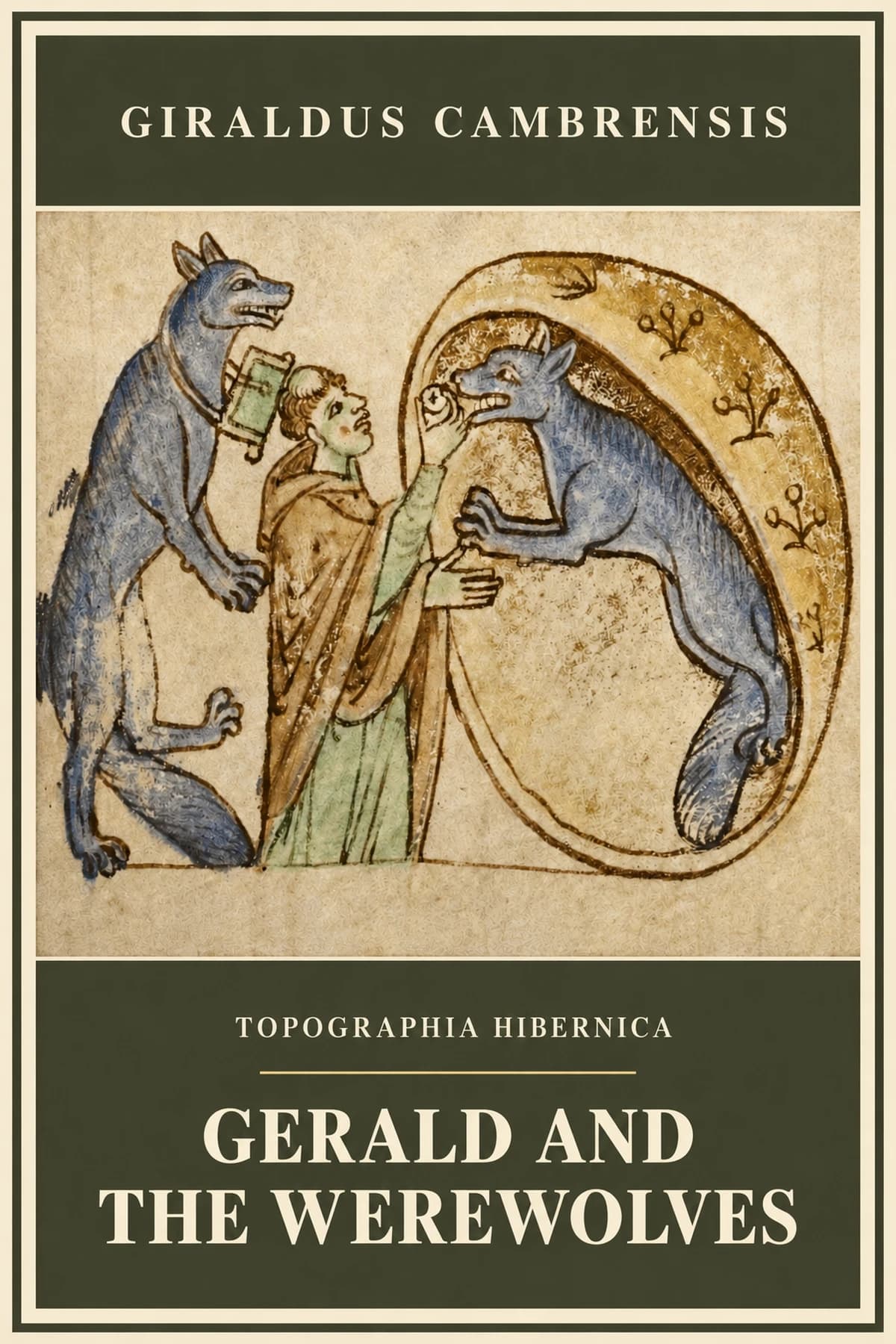
The story
A talking wolf in a wood on the borders of Meath.
About three years before the Lord John came to Ireland, a priest travelling from Ulster toward Meath stops for the night in a wood on the borders of Meath, with only a small boy for company. As they sit by their fire under a tree, a wolf comes up and speaks: don’t be afraid. The two are terrified. The wolf talks about God, sensibly. The priest makes it swear by the Trinity that it will do them no harm and say what it is, and it gives a perfectly orthodox answer.
Then it explains. It belongs to a people of Ossory who live under the curse of a holy man, the abbot Natalis. Every seven years, two of them, a man and a woman, are driven out of both their human shape and their homeland. They take off the human form completely and put on a wolf’s. If they survive the seven years, two others take their place and they go home, human again.
Its partner in this exile is lying very ill nearby. Will the priest come and give her the comfort of a priest before she dies? The trembling priest follows the wolf to a hollow tree and finds a she-wolf inside, groaning and weeping like a human being. She greets him in a human way and thanks God for sending him.
He gives her the last rites, but she begs for communion too, and he says he has none with him. The wolf points out the little pouch hanging round the priest’s neck: a book and some consecrated hosts, as travelling priests in that country carried them. Then, to remove all doubt, the wolf uses its paw like a hand and peels the skin back from the she-wolf’s head down to her navel. Inside is an old woman. The priest gives her communion, “out of terror more than reason”, and the skin closes back over her.
The wolf keeps them company by the fire all night, “more like a man than a beast”. In the morning it leads them out of the wood, shows the priest his road, and thanks him, promising far greater thanks if God ever calls it home from an exile it has already served two parts of. Before they part, the priest asks one more question: will the foreign people who had come into the island stay there long? The wolf’s answer is a warning. They will stay safe as long as they keep God’s commandments; but if, living among the Irish, they sink to their ways, they will bring God’s punishment on themselves too.
Gerald was asked to rule on it
This isn’t a story Gerald heard at second hand.
About two years later, he writes, he was travelling through Meath when the bishop there had called a synod, with neighbouring bishops and abbots, to decide what to do about the priest’s confession. The bishop sent two clerics to ask Gerald to attend. He couldn’t come, so he gave his advice by letter. Following his advice, the bishop and synod sent the priest to the Pope, with letters setting out what had happened, sealed by the bishops and abbots who were present.
Gerald’s editor, J. F. Dimock, notes that Gerald insisted what he wrote in the Topographia rested on his own eyes or on testimony carefully gathered from trustworthy witnesses (the note is in the reader).
Beast or man?
Gerald thinks it through.
The second half of the chapter is Gerald arguing with himself. God took on human nature to save the world; a man taking on a wolf’s nature at God’s will is no lesser miracle, and just as much to be believed. But then:
Gerald of Wales · Topographia Hibernica II.19
Tap a word — or reveal the translation.
But is a creature like this to be called a beast or a man?
A rational animal is a long way from a brute. Who would call a four-footed animal, facing the ground and unable to laugh, human? And if someone kills one, is it murder? Gerald works through Augustine’s City of God: the monstrous races of the East; the Arcadians who swam a lake and became wolves for nine years; the Italian innkeepers’ wives said to turn travellers into pack animals with cheese; and Apuleius, who became an ass in The Golden Ass with his human mind intact. Then come stories from Gerald’s own time: men who sold fat red pigs at fairs, pigs that vanished as soon as they crossed water, and old women in Wales, Ireland and Scotland who turn into hares to steal milk. His conclusion, with Augustine: demons and evil men can change only how things look, while God can truly change what they are.
The Latin, in three lines
The wolf introduces himself:
Gerald of Wales · Topographia Hibernica II.19
Tap a word — or reveal the translation.
We are of a certain people, the men of Ossory. How the curse works:
Gerald of Wales · Topographia Hibernica II.19
Tap a word — or reveal the translation.
They take off the human form completely and put on a wolf’s. And Gerald’s verdict on the priest’s communion:
Gerald of Wales · Topographia Hibernica II.19
Tap a word — or reveal the translation.
So these things were done by the rite, rather than rightly…
What the Latin is like
An easy story, and a hard argument.
It scores 6.6 on Librorum Capsula’s 1–11 difficulty scale (reviewed): Intermediate, near the top. The story itself is the easier part (it opens at 5.0): narrative, a few speeches, plain medieval prose. The hard part comes later (8.0), in the long theological sentences where Gerald quotes Augustine and argues about natures and forms.
In the reader
The complete chapter, with every word defined.
The complete chapter, Topographia Hibernica Distinctio II, chapter XIX: 1,267 words. The text is J. F. Dimock’s Rolls Series edition (Giraldi Cambrensis Opera, vol. V, 1867). Medieval spellings are kept as printed, long vowels are marked throughout, and every word has a definition, lemma and form.
Read next
Petronius’s werewolf → · Roman ghost stories and Latin horror stories →
The Werewolf of Petronius
A thousand years earlier, a soldier strips by the roadside tombs.
Narratio de Arthuro rege Britanniae et rege Gorlagon lycanthropo
A werewolf king who keeps a human mind.
Sources & further reading
- Gerald of Wales, Topographia Hibernica, Distinctio II, cap. XIX, in James F. Dimock’s Rolls Series edition (Giraldi Cambrensis Opera, vol. V, 1867)